A Wilderness Beyond Sight
Navigating the Boundary Waters with a Vision Loss
For Kelly Carver, the essential challenge of trips into the Boundary Waters is not paddling across windswept lakes, navigating rocky portages, or even cooking over an open fire. It’s doing all of this while legally blind.
When Carver returns to camp after a trip to the latrine, he’s counting steps. Two hundred paces out, two hundred back. If he doesn’t catch the scent of the latrine by then, he backtracks and tries again. His hiking pole, extended slightly longer than usual, sweeps the ground in front of him, searching for roots, rocks, and dips in the terrain that his eyes can no longer detect.
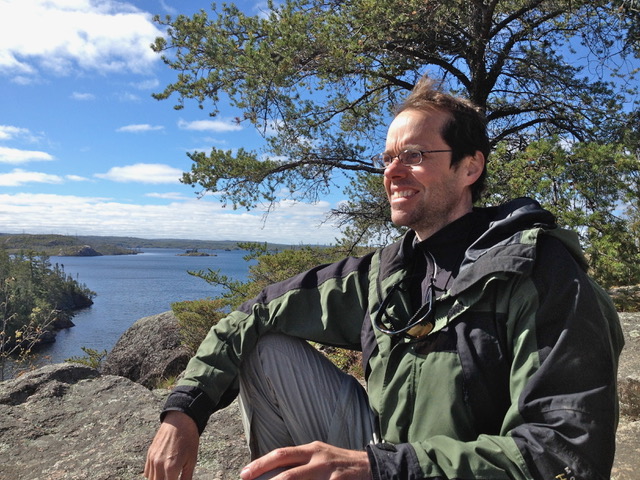
This meticulous attention to detail extends to every aspect of his time in the wilderness. His Leatherman knife has to be in his pocket or in a specific compartment of his equipment bag in the tent, nowhere else. His spices are stored in different-shaped containers so he can identify them by touch. When he sets up the camp kitchen, everything has a place, and his paddle partner knows not to move anything. “If things get scattered, I am lost,” Carver says.
It was a winter trip that first brought Carver to the Boundary Waters in the spring of 1982. He was a student at the University of Minnesota when a classmate asked if he wanted to go to the Boundary Waters over Spring Break.
When his friend showed him how the lakes and islands on the Fisher map were connected in ways that seemed almost magical, Carver agreed. They rented a couple of winter sleeping bags and Duluth packs from the student center, threw Carver’s cheap two-person pup tent in the car, along with plenty of ramen and instant oatmeal, and headed north.
When they arrived at East Bearskin Lake, the lakes were still locked in ice. Snow covered the forest. They set out across the frozen expanse of Duncan Lake, their boots crunching on wind-packed snow. The cold pierced through their clothing. And that’s when the adventure truly began.
Carver’s friend Tom broke through the ice up to his knees. That night, they struggled to start a fire. A storm rolled in. The driving snow caused whiteout conditions, and they wondered if they’d made a mistake.
Then they saw something that made it all worth it: a mother wolf and her pup crossing Rose Lake. Dark shapes moving with purpose across the white expanse, utterly wild and utterly at home. The image burned itself into Carver’s memory. It was the stark beauty of witnessing something so raw and real.
When he returned home, Carver felt certain of one thing: part of his soul was up there, in that wilderness of frozen lakes and old-growth forest, in the challenge and the silence and the raw beauty of it all. He would return. He had to.
But the following year, everything changed.
Carver went to the student health center expecting to get a prescription for glasses. Instead, he received a diagnosis of retinitis pigmentosa, a degenerative retinal disease. The immediate issue was cataracts, which had been clouding his vision. But the larger truth was inescapable: his peripheral vision was shrinking and would continue to shrink until there was almost nothing left.
“I was terrified,” Carver says now. “When you ask people what they fear the most, Blindness is really up there.”
Nine years after his diagnosis, his field of vision had shrunk to less than 20 degrees. A typical field of vision is 180 degrees side to side and 140 degrees top to bottom. Carver was working with 20 degrees. He had crossed the threshold into legal blindness.
But he kept returning to the Boundary Waters.
Grief came in waves. On the lakes, Carver mourned the shorelines he could no longer clearly see. The visual magic of the place, the Canadian Shield, the mist rising off the water, the sun highlighting the red pines and white pines and jack pines along the islands, were lost to him.
“There’s no sugarcoating that,” he says quietly. “It’s a very hard loss, especially when you’ve had a chance to have vision and be part of the visual world.”
For years, Carver fought this new reality. He avoided the word “blind,” calling himself anything else: someone with tunnel vision, someone who was night blind, someone who didn’t see very well.
But as his vision continued to deteriorate, something shifted. Rather than fighting what he couldn’t change, he began to adapt.
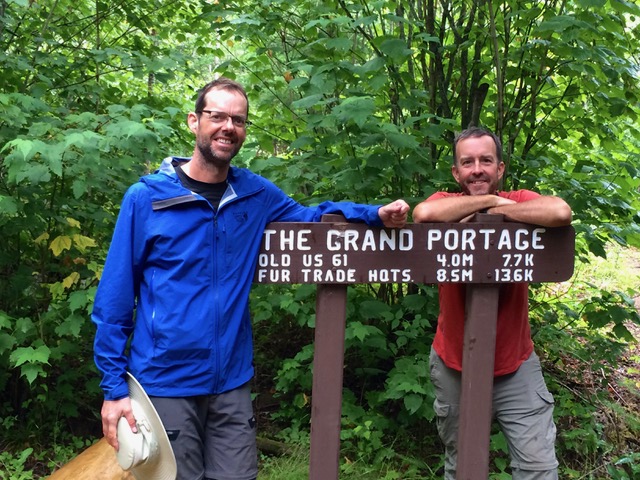
Ten years ago, this past summer, Carver and his longtime paddle partner Ken Backhus completed an extraordinary journey. Starting at Crane Lake, they traveled the entire border route — 220 miles, 36 lakes, five rivers, and 45 portages — ending at Lake Superior. The trip culminated with Carver walking the legendary nine-mile Grand Portage alone, carrying a pack while Ken carried the canoe ahead of him.
They completed it in thirteen days, with one rest day at Rose Lake. Carver was 52 years old and legally blind.
The expedition wasn’t without its challenges. On Prairie Portage, winds hit 40 miles per hour as they crossed Knife Lake, waves crashed sideways across the bow. “I seriously thought we were going to swamp,” Carver recalls. Another day, crossing a small ripple in the water near Curtain Falls, their canoe inexplicably flipped. Responding quickly, the two managed to get everything back inside and kept going.
For Carver, adaptability has been everything. In the early years, he paddled from the stern, weaving across lakes while Backhus called out directions: “Eleven o’clock, Kelly. Ten o’clock.” But as his vision deteriorated further, they switched positions. Now Backhus steers while Carver paddles up front, and they’re back to holding a straight line, even though they might miss a few rocks up front.
On portages, which Carver says are the most challenging part of any trip, he keeps his pack straps tight, moving as “one unit” to avoid losing balance when his feet search for secure footing on terrain he cannot see. He extends one hiking pole slightly longer than the other, using it to scan the trail ahead like a cane.
At campsites, Backhus does a verbal walkthrough of the layout while Carver maps it in his mind, using his poles to feel out rises, dips, and obstacles. In the absence of vision, he has allowed his other senses to slowly take over. Touch and hearing have become paramount for him. The breeze through the pines, the lazy drift of a bumblebee in September, the chipmunks chattering near camp. Smell guides him to the latrine.
The visual memories are still with him, and when someone mentions the Boundary Waters, those images flood back. But these days, he’s learned to let that piece go, to stop trying to see what’s no longer there.
“There are just so many ways to enjoy being in that amazing country,” he says. “I’ve spent years fighting this, and I’m fighting a losing battle. So as a means to get the most out of what I’m doing, it’s best just to let go.”
The journey to where Carver is today hasn’t been easy. But along the way, he’s encountered the kindness of strangers, the attentiveness of friends, the concern people show when he’s out doing difficult things. He’s learned that in order to do what he wants to do, he can’t do it alone.
“I grieve a lot less about it now,” Carver reflects. “This is who I am, and I can still be all of these things: a husband, a father, a friend, a cook. I can still be exploring the Boundary Waters. It’s just part of who I am now.”
Today, the satisfaction of being out in the Boundary Waters far outweighs the fear. As Carver first discovered on that first winter trip in 1982: the Boundary Waters is a place that belongs to everyone willing to step outside their comfort zone and willing to adapt.
As he prepares to return to the place that has had such an impact on who he is, Carver reminds all of us that there are countless ways to experience the Boundary Waters, and that sometimes the most profound visions come from beyond sight.

Listen to Kelly in his own Words on “Big Red Canoe” Podcast
To hear Kelly Carver share his remarkable Boundary Waters journeys in his own voice—listen to the episode “A Wilderness Beyond Sight” on our Big Red Canoe Podcast.
In each episode, host David Meier, who is also the Sr. Marketing and Communications Manager here at Friends, interviews people on topics ranging from wilderness travel and adaptation, to science, history and, most importantly, the stories that connect us to this treasured place.
Find Friends’ Big Red Canoe podcast wherever you get podcasts by searching for “Big Red Canoe.”
Continue Reading
Announcing the Friends’ 2026 Photo Contest
Got a great shot from the Boundary Waters? Enter our annual photo contest for a chance to win one of…
Tell the Army Corps to Reject NewRange-Polymet Wetlands Permit
Voice your concerns about the NewRange-Polymet wetlands permit in Minnesota, and protect the environment from polluting projects.

The Roadless Rule and the Boundary Waters: What's at Stake
The federal government wants to rescind the Roadless Rule, stripping protections from 45 million acres of national forest — including…