The Senate Passed HJR 140. Here’s What That Means for the Boundary Waters — and What We Do Next.
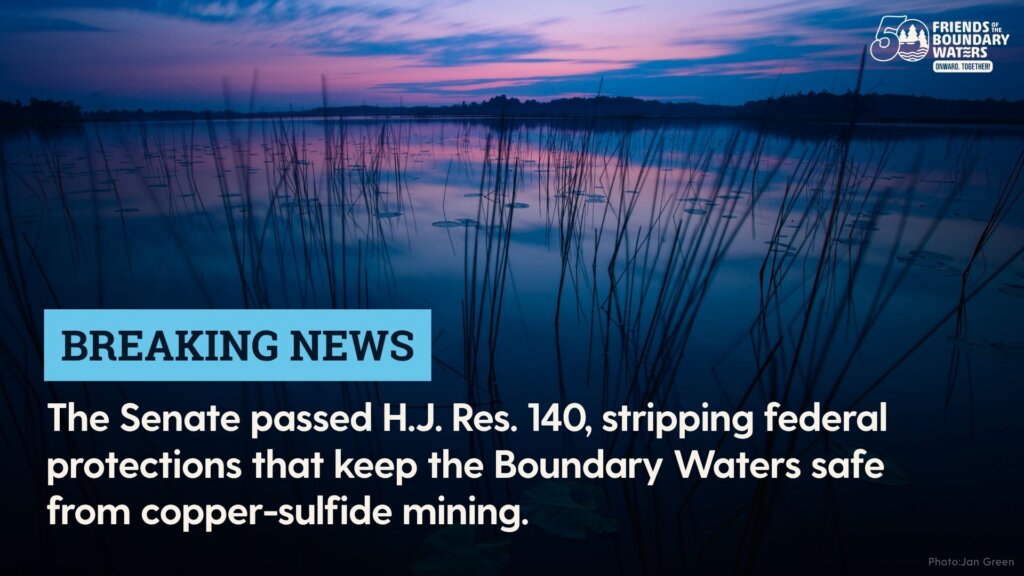
The United States Senate has passed H.J. Res. 140. And April 27, 2026, President Trump signed it into law.
This is a serious blow to the Boundary Waters and to the future of America’s public lands. This is hard news. We are not going to pretend otherwise.
With a single procedural vote, the Senate stripped federal protections from 225,000 acres of public land surrounding the Boundary Waters Canoe Area Wilderness. They discarded a comprehensive two-year environmental study. They ignored more than 650,000 public comments, the overwhelming majority of which opposed mining in this pristine watershed. They did all this in order to lay out the red carpet for a Chilean mining conglomerate to build a toxic copper-sulfide mine at the edge of America’s most visited wilderness.
Elected officials chose the interests of a foreign mining company over the will of the American people, over sound science, and over one of the most irreplaceable wild places in the United States.
While we need to acknowledge this loss, this is no time to sulk. This is a time to act.
This is not the end. Here is everything you need to know about what just happened, why it matters, and what comes next.
Why the Senate Just Sold out the Boundary Waters
H.J. Res. 140 was a Congressional resolution introduced by Minnesota Congressman Pete Stauber. It passed the House and cleared the Senate with a simple majority — a threshold that, under the Congressional Review Act, does not require 60-vote majority and cannot be stopped by a filibuster.
The resolution used the Congressional Review Act to overturn the Biden administration’s January 2023 mineral withdrawal — a federal order protecting approximately 225,000 acres of public land in the Rainy River watershed from sulfide-copper mining. With the Senate’s passage and the president’s anticipated signature, that protection is gone.
In plain terms: the Senate voted to hand the Boundary Waters watershed to a foreign mining company.
What Was Destroyed in This Vote
What the Senate voted to undo was not a rushed executive action. It was the result of one of the most thorough public land reviews in recent American history.
The Forest Service spent two years conducting a comprehensive, science-based examination of what sulfide-ore copper mining would mean for the Rainy River watershed. That review drew on extensive hydrological, ecological, and economic analysis. It examined how acid mine drainage — the toxic byproduct of sulfide-ore mining — could contaminate the interconnected system of lakes and streams that defines the Boundary Waters.
It also included a public comment process unlike almost anything the agency has seen. More than 650,000 Americans submitted comments. The overwhelming majority opposed mining near the Boundary Waters.
The result was the 20-year mineral withdrawal: a science-grounded, democratically informed decision to protect one of the most ecologically sensitive and economically vital Wilderness Areas in the country.
With today’s vote, the Senate set all of that aside. The science was discarded. The public comments were ignored. The democratic process was overridden by a procedural maneuver designed to benefit a single foreign corporation.
The Threat That Just Got Closer: Twin Metals and Antofagasta
Twin Metals Minnesota is the company that has been seeking to build a copper-sulfide mine in the watershed immediately upstream of the Boundary Waters. It is a wholly owned subsidiary of Antofagasta, a foreign mining corporation based in Chile.
Sulfide-copper mining poses uniquely severe environmental risks when sited near a watershed like the Boundary Waters. When sulfide minerals are exposed during mining operations, they react with air and water to generate sulfuric acid. That acid can then leach heavy metals, including copper, arsenic, and lead, into surrounding waterways — a process known as acid mine drainage that can persist for centuries and is essentially irreversible once it begins.
The Boundary Waters is not a single lake. It is a connected wilderness of more than 1,000 lakes and hundreds of miles of streams. Contamination introduced anywhere in the watershed can spread throughout the entire system. There is no wall between a mine and the water. There is no remediation technology that has successfully prevented acid mine drainage in a comparable setting. Not a single major sulfide-ore copper mine operating near a watershed like the Boundary Waters in the United States has done so without causing significant, lasting environmental damage.
The Boundary Waters draws more than 150,000 visitors each year. It supports one of the most significant outdoor recreation economies in Minnesota. Its water quality and ecological integrity are not amenities — they are the foundation of everything the wilderness is and everything it provides to the people and wildlife that depend on it.
With federal protections stripped, Twin Metals now has a substantially clearer path to pursuing the permits needed to build that mine.
How the Congressional Review Act Was Weaponized
The mechanism behind H.J. Res. 140 was the Congressional Review Act — a law enacted in 1996 to give Congress a streamlined path to review and overturn federal agency actions. Under the CRA, a resolution of disapproval requires only a simple majority in both chambers and cannot be filibustered. Congress has 60 legislative days from the submission of a federal action to pass such a resolution.
Republican lawyers argued that the Biden administration had failed to properly submit the 2023 mineral withdrawal to Congress as required under the CRA. Three years after the withdrawal was issued, the Trump administration “rediscovered” this alleged procedural oversight and resubmitted the Public Land Order to the now-Republican-controlled Congress — fully expecting it to be rejected.
What makes this use of the CRA especially alarming is its potential permanent consequence. Under the CRA, when Congress overturns a federal action, it may bar any future administration from implementing a substantially similar action without new legislation. Applied to the Boundary Waters mineral withdrawal, legal experts have warned this could mean no future president — regardless of what the science shows or what the American people want — would ever be able to re-implement comparable protections for this watershed without an act of Congress.
The Senate just voted to make that the law. Science, the public, democratic process, all of this was overridden, not just today but potentially forever. This was done by a procedural vote that required a simple majority. And it took a matter of hours.
What You Did to Fight This
We want to be direct about something: you fought hard. Thousands of Boundary Waters supporters called their senators. They sent emails. They contacted Senate offices across the country. They made it politically costly to cast a visible vote in favor of handing public lands to a foreign mining company.
You made this fight harder than it should have been. You made senators think twice. And in a closely divided Senate where the resolution needed only a simple majority, that pressure mattered — even if it was not enough today.
That organizing infrastructure, that demonstrated willingness to engage, that network of people who refuse to look away — it is not gone. It is going to be the foundation of what we build next.
This Fight Is Not Over: What Options Remain
The Senate’s vote is a serious setback. It is not the end. Here is where the fight goes from here.
Legal challenges. Friends of the Boundary Waters is working with legal partners to examine every available avenue to challenge the resolution’s validity and its application to the mineral withdrawal. The use of the Congressional Review Act against a public land order of this kind is legally unprecedented, and that novelty may create grounds for challenge. We will pursue every viable option.
Minnesota state action — the DNR’s mineral leases. Twin Metals holds mineral leases on land administered by the Minnesota Department of Natural Resources. Those are state leases, not federal ones. The DNR Commissioner has independent authority to review and cancel one of those leases. Canceling this lease would not put an end to the Twin Metals project, but it would be a crucial first step. This action would be the precedent that could lead to the State canceling all of Twin Metals’ State leases in the coming years. This is a long game that starts today! Friends of the Boundary Waters has been pressing the commissioner to exercise that authority, and the urgency of that push has increased dramatically with today’s vote.
State permanent protection legislation. The Minnesota Legislature is considering legislation that would establish state-level protections for the Boundary Waters watershed independent of federal action. These are protections no future congressional resolution could undo. Passing that bill is now more important than ever. It represents the clearest path to durable, mining-proof protection for the Boundary Waters.
Federal reversal. A future administration — one that values public lands, science, and democratic process — could seek to re-implement protections for the Boundary Waters through new legislation or alternative legal mechanisms. The CRA’s restrictions on re-implementing similar rules complicate this, but they do not necessarily foreclose it. The political path runs through elections, organizing, and sustained public pressure.
None of these paths is easy. All of them are worth pursuing. And all of them require sustained, organized, well-resourced advocacy — the kind Friends of the Boundary Waters has been building for 50 years.
The Permanent Danger of This Precedent
Beyond the immediate threat to the Boundary Waters, today’s vote sets a precedent that should alarm everyone who cares about America’s public lands.
If the Congressional Review Act can be used to overturn a mineral withdrawal for the Boundary Waters, it can be used for any public land protection anywhere in the country. The same mechanism that just stripped protections from one of the most beloved wilderness areas in the United States could be applied to national monuments, wildlife refuges, or any other federally protected land with a procedural argument and a willing congressional majority.
This vote is not just about the Boundary Waters. It is about whether public land protections are durable commitments or temporary arrangements that can be erased the moment political power shifts. That question has now been answered. The answer will shape the future of America’s public lands for decades.
What You Can Do Right Now
The most important thing you can do today is stay in this fight!
Support Friends of the Boundary Waters Wilderness. Your financial support funds the legal work, the state-level advocacy, the grassroots organizing, and the communications infrastructure that keep us effective in a sustained, long-term campaign. The next phase of this fight will not be won quickly, and it will not be won cheaply.
Contact the Walz and DNR. Urge the ommissioner to cancel Twin Metals’ state mineral leases. The state has tools that Washington cannot touch — but only if the people in charge of those tools are willing to use them.
Contact your state legislators. Support permanent state-level protection legislation for the Boundary Waters watershed. Make it clear to your representatives that this is a priority — not just in the weeks after a bad vote in Washington, but consistently, over time.
Stay informed and stay engaged. The Boundary Waters has survived for 50 years because people refused to look away between crises. That is what the next chapter requires too.
Frequently Asked Questions About the Senate Passage of HJR 140
Did the Senate pass HJR 140? Yes. The United States Senate passed H.J. Res. 140, a Congressional resolution that uses the Congressional Review Act to overturn the Biden administration’s 2023 mineral withdrawal protecting 225,000 acres of public land surrounding the Boundary Waters Canoe Area Wilderness. And April 27, 2026, President Trump signed it into law.
What does the passage of HJR 140 mean for the Boundary Waters? The passage of H.J. Res. 140 strips federal protections from 225,000 acres of public land in the Boundary Waters watershed, opening that land to potential sulfide-ore copper mining by Twin Metals Minnesota. It also potentially bars future administrations from re-implementing similar protections.
Is mining in the Boundary Waters now guaranteed? No. The Senate vote removes a key federal protection, but Twin Metals still needs additional federal and state permits to proceed with mining. State-level protections, including the Minnesota DNR’s authority to cancel one of Twin Metals’ mineral leases, remain in place and represent a critical line of defense.
Can the Boundary Waters be protected after this vote? Yes, though the task is harder. Legal challenges to the resolution are being explored. we are pressuring Minnesota DNR to exercise its independent authority to cancel one of Twin Metals’ state mineral leases in 2026. The Minnesota Legislature can pass permanent state-level protection legislation. And a future federal administration could seek to re-implement protections through alternative legal mechanisms or new legislation.
What is the Congressional Review Act and why was it used here? The Congressional Review Act is a 1996 federal law that allows Congress to overturn certain federal agency actions with a simple majority vote in both chambers, without the possibility of a filibuster. The Trump administration resubmitted the Biden-era Boundary Waters mineral withdrawal to Congress, triggering a 60-day window in which the Republican-controlled Congress could — and did — vote to nullify it.
What is the long-term danger of this precedent? Legal experts warn that if the CRA can be used to overturn a mineral withdrawal, it could be used against any public land protection. The CRA also potentially bars future administrations from implementing substantially similar protections, meaning the vote may restrict the ability of future presidents to protect the Boundary Waters regardless of scientific evidence or public demand.
Who is Twin Metals Minnesota and who owns it? Twin Metals Minnesota is a mining company seeking to build a sulfide-ore copper mine in the watershed upstream of the Boundary Waters. It is wholly owned by Antofagasta, a multinational mining corporation headquartered in Santiago, Chile.
What is sulfide-copper mining and why is it dangerous near the Boundary Waters? Sulfide-ore copper mining involves extracting copper from rock containing sulfide minerals. When those minerals are exposed to air and water, they can generate sulfuric acid, which leaches heavy metals and toxins into surrounding waterways — a process called acid mine drainage. Because the Boundary Waters is a highly interconnected watershed, contamination can spread throughout the entire wilderness system. No major sulfide-ore mine near a comparable watershed in the United States has operated without significant environmental damage.
What can I do to protect the Boundary Waters now? Support Friends of the Boundary Waters Wilderness financially and stay engaged. Contact Minnesota DNR to urge cancellation of one of Twin Metals’ state mineral leases. Contact your state legislators to support permanent state-level protection legislation. And stay informed.
The Boundary Waters has survived 50 years of attacks because people refused to give up.
The fight isn’t over. Support our work to protect the Boundary Waters.
Continue Reading

Announcing the Friends’ 2026 Photo Contest
Got a great shot from the Boundary Waters? Enter our annual photo contest for a chance to win one of…
Tell the Army Corps to Reject NewRange-Polymet Wetlands Permit
Voice your concerns about the NewRange-Polymet wetlands permit in Minnesota, and protect the environment from polluting projects.

The Roadless Rule and the Boundary Waters: What's at Stake
The federal government wants to rescind the Roadless Rule, stripping protections from 45 million acres of national forest — including…