Building a Plan for Climate Resilience in Northeastern Minnesota
When Friends of the Boundary Waters Wilderness was founded nearly 50 years ago, the threat was clear. Motorboats and chainsaws, the timber and mining industries stood as the immediate threats to the wilderness. Our founders understood that in a world racing toward industrialization and extraction, there should be places set aside and protected from the modern world. For half a century, Friends has fought to keep those threats at bay, to draw a line between wilderness and the machinery of industry.
But climate change presents a fundamentally different challenge. You can ban motors from the Boundary Waters. You can stop mining companies at the border. But you cannot keep out the warming air, the changing precipitation patterns, or the cascading effects of a rapidly heating planet. Climate change knows no borders. It does not stop at the edge of the wilderness, and it cannot be defeated by a court ruling or an act of Congress alone.
The Boundary Waters could undergo a dramatic transformation within our lifetimes. The boreal forest, composed of spruce and fir, paper birch and aspen, defines northeastern Minnesota. These are trees that have adapted to thrive through long, cold winters, conditions in which southern species such as oak and maple struggle to survive. But warming temperatures are breaking down that natural barrier. Oak and maple saplings are already creeping north, taking root in forests that were once too cold to support them.
The boreal ecosystem could change even faster if triggered by climate-driven events like severe droughts, massive insect outbreaks, or catastrophic wildfires that clear the way for southern species to take over.
The impacts extend far beyond the trees. Moose, already stressed by warming conditions, face an uncertain future. Lake trout and other cold-water fish could disappear from many lakes. Ciscoes, the small fish that form the foundation of the aquatic food chain, are projected to vanish from hundreds of Minnesota lakes by 2100, threatening the walleye, bass, and trout populations that depend on them. Even the iconic call of the loon could become a memory, as black fly populations explode in the warmer and wetter conditions drive loos to abandon their nests.
The question, then, is not whether climate change will affect the Boundary Waters, but how we adapt to a world with bigger and hotter fires, increased risk of floods, spread of invasive species and shorter, warmer winters. How do we build resilience in the face of a threat that cannot be stopped at the wilderness boundary?
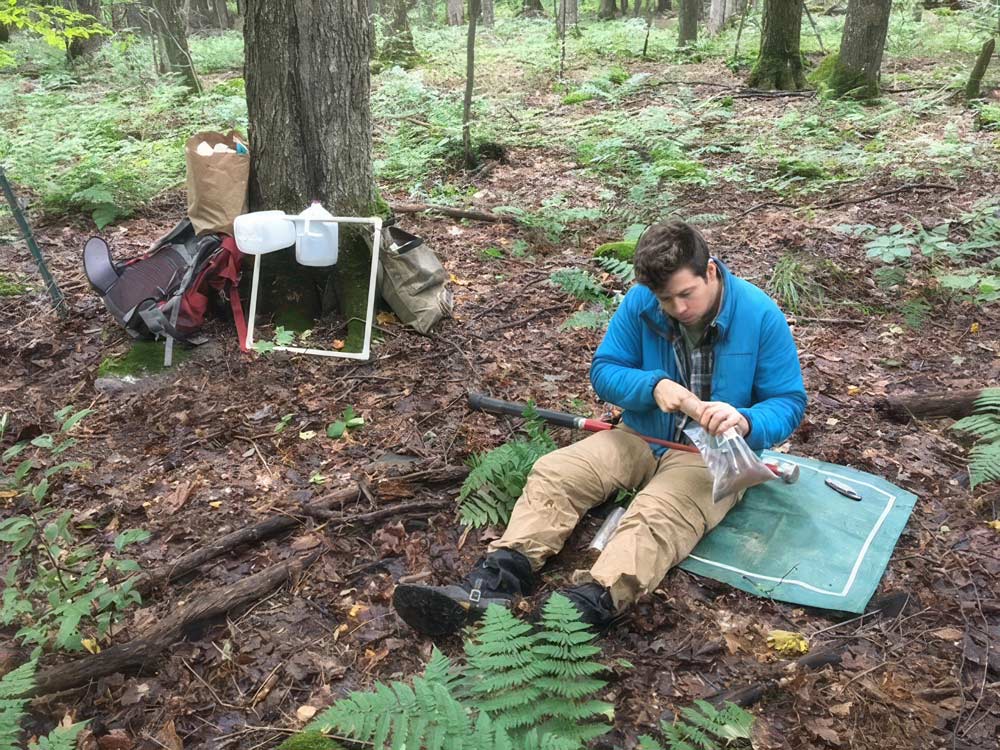
These questions of climate resilience and adaptation are at the center of Friends’ new Climate and Conservation Program, which we launched this fall.
The obvious answer to these problems is to take a science-based approach. However, the sheer volume of research can make it hard to collect all the data needed to make the best possible decisions.
The initial challenge we are trying to tackle with this program is dealing with the fragmentation of data and research. Numerous government agencies, tribal nations, academic institutions, and conservation organizations have conducted climate research in northeastern Minnesota. However, that information remains scattered and siloed across multiple databases and sources. This makes it difficult to develop a comprehensive understanding of how climate change is affecting the region’s habitat and wildlife, and even harder to know how to respond.
By aggregating the vast amount of research that has been conducted into how climate change is affecting northeastern Minnesota, the program aims to provide policymakers and researchers, land managers and organizations, with a public, web-based database where the most up-to-date research is available.
At the helm of this effort is Dr. Sam Reed, who joined Friends this fall as our Climate Change and Conservation Manager.
“Selfishly, I wish something like this existed when I was in graduate school. Right now, if you type in ‘Climate Change northeastern Minnesota,’ you turn on a fire hose of information that is very difficult to sort through,” says Reed.
After completing his PhD in Natural Resources Science & Management with Dr. Peter Reich and Dr. Lee Frelich at the University of Minnesota, Reed spent the next several years at the University of Minnesota’s Institute on the Environment as a Postdoctoral Fellow. There, he worked with the U.S. Geological Survey’s Midwest Climate Adaptation Science Center and the Midwest Carbon Leadership Project to tackle climate change and biodiversity loss.
What drew him to Friends was the opportunity to do something truly forward looking.
“When it comes to climate change, northeastern Minnesota is one of the most vulnerable regions on the planet. It also happens to be one of the most studied and most researched areas,” says Reed.
Based on preliminary searches, Reed estimates there are 9,000 to 10,000 papers that may be relevant to a comprehensive understanding of climate change in northeastern Minnesota. Once he sorts through them, he estimates that anywhere from 500 to 1,000 papers will be included in the database.
But collecting, reading and organizing all these papers is only part of a much larger project.
Ultimately, gathering this collective knowledge will help create plans to manage the Boundary Waters and surrounding area in a way that allows it to adapt and thrive in a warming world.
“We can shape what northeastern Minnesota might look like with climate change. The beauty of climate adaptation is that it offers hope in a rapidly warming climate. It allows us to develop strategies we can put in place, that people can rally around to ensure we have healthy and thriving ecosystems in the future. We are creating a vision for the future.”
Learning to live with climate change may be just as important as stopping or slowing carbon emissions.
Reed points out that Native Nations in Minnesota and the Upper Midwest have been at the forefront of climate adaptation for years, often leading where others have been slow to follow. Tribal communities with deep connection to the land and treaty rights depend on healthy ecosystems, have long understood what is at stake as the climate shifts.
In particular, the Great Lakes Indian Fish & Wildlife Commission (GLIFWC), which serves eleven Ojibwe tribes across Minnesota, Wisconsin, and Michigan, has inspired Reed’s work. Their Climate Vulnerability Assessment and Climate Adaptation Menu offer beautiful illustrations and stories about what is at stake, while providing concrete, place-based strategies grounded in both Western science and Traditional Ecological Knowledge.
Reed has already begun connecting with folks from GLIFWC and forming relationships with tribal scientists and resource managers to understand how Friends’ program can support their climate adaptation efforts and advance treaty rights.
This kind of relationship building is an essential part of Reed’s work. Since coming on, he spends much of his time plumbing his contact list and meeting with tribal organizations, government agencies, researchers, and conservation groups to understand what climate information they truly need and where to find important data that might otherwise remain hidden.
“I don’t want to create something no one uses,” Reed says. “Meeting with people is a way to figure out the needs of different communities and organizations. For my own work, people can point me to important research and give me good ideas on where to look.”
These conversations range from forest succession models to citizen science projects to how artists are depicting climate change in the Northwoods. Like so much important work in the environmental field, climate adaptation is fundamentally about connecting with people.
“I do like talking with people,” Reed admits. “The beauty of this position is I can reconnect with people and talk to them about one of the most climate-vulnerable places in the US, and they get excited that Friends is working in this space.”
The Boundary Waters is a federally protected Wilderness Area and traditionally, conservationists thought the best way to manage it was to simply leave it alone.
But leaving it alone, doing nothing, Dr. Reed emphasizes, is itself a management decision. “While having such a large, protected area like the BWCA offers substantial climate resilience, by doing nothing we are allowing human-made climate change to have its way with the area. It is really not ‘leaving it alone.'”
It’s also not how people have historically related to this landscape. “We’ve certainly been able to tear nature down, so we can also help build it back up,” Reed says. “Tribal nations have been doing that forever. It’s a reciprocal relationship.”
Ultimately, Reed sees this as a hopeful project. And hope is something missing in much of the discussion around climate change. By collecting the data and research, we’ll be in a better position to adapt to the changing climate. This is particularly important at a time when the federal government is not only cutting funding for climate change research but scrubbing websites and public databases of information that was once freely available.
“Even if the powers that be don’t turn off the carbon spigot, there are things we can do to maintain a functional, thriving, beautiful ecosystem,” Reed says. “We do have some measure of control over this.”
Continue Reading
Fifty Years of Fighting for the Wilderness
In 1978, we helped save the Boundary Waters. Today, the fight isn't over. Meet the organization that has never stopped…
Minnesota Has the Power to Stop Twin Metals – Here’s How
Minnesota has a clear legal pathway to stop the Twin Metals mine by canceling its lease - but we need…

Winners of the 2025 Boundary Waters Photo Contest
Discover the winners of the 2025 Boundary Waters Photo Contest, showcasing paddling, wildlife, landscapes, and special moments captured across the…