Podcast: The Trail Finds You
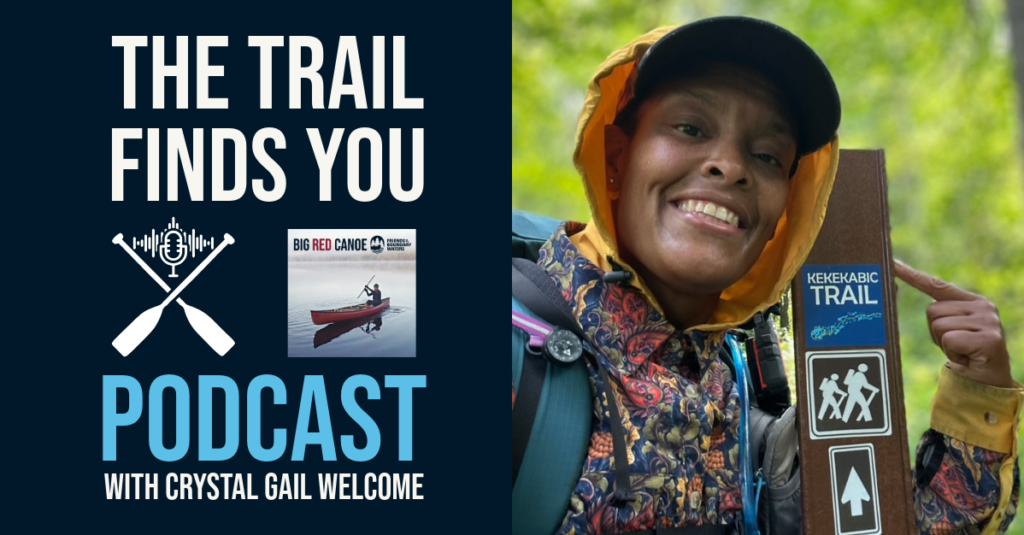
The Superior Hiking Trail turns 40 this year. Three hundred miles of North Shore ridgeline, from the Wisconsin border to the edge of the Boundary Waters region, the SHT has shaped the lives of everyone who’s walked it. Crystal Gail Welcome is one of those people — and on this podcast, she shares the story of her final through-hike: a solo back-to-back of the Kekekabic and Border Route Trails, deep in the Boundary Waters wilderness. After years of pushing through a rare brain disease to walk some of the longest trails in North America, she’s closing this chapter and moving forward into whatever comes next.
She didn’t grow up in Minnesota, and she didn’t grow up hiking. But a rare brain disease and a stubborn refusal to be sidelined sent her down a path that wound through the Pacific Crest Trail, the Superior Hiking Trail, the Florida Trail and the Great Western Loop — and ultimately north to the Boundary Waters.
Now she lives in Grand Marais, volunteers with Trail Mix Alliance, an organization that empowers women and underserved communities through outdoor education, leadership, and stewardship, and Footprints for Change which campaigns to get historically excluded folks out in nature.
In this episode of Big Red Canoe, we talk about what those final miles were really like, what the SHT gave her and why she stayed on the North Shore, how the outdoors became therapy long before she earned a master’s degree in adventure therapy, and why wild places like the Boundary Waters matter for all of us, especially those who need them most.
If you’ve ever thought about hiking the SHT, exploring the Border Route, or paddling into the Boundary Waters, or if you just need a reminder of why any of it matters, you’ll want to hear this conversation. There’s a reason people come back to these places. The Boundary Waters and North Shore have a way of quieting the noise, resetting the body, and returning us to something essential. Call it mindfulness. Call it medicine. Crystal calls it home.
Links and resources
Transcript
Crystal Gail Welcome: Living with a neuromodulator and being a backpacker the more people told me I couldn’t do stuff, the more I started to do those things. And so what are you limited by, and is it really a limit?
Narrator/Dave Meier:
Welcome to Big Red Canoe, the podcast from Friends of the Boundary Waters Wilderness, where we introduce you to captivating people and intriguing stories from America’s Treasured Wilderness. I’m Dave Meier. Grab a paddle and hop on in.
Dave Meier: The Superior Hiking Trail is turning 40 this year. 300 miles of North Shore ridgeline that has shaped the lives of everyone who’s walked it. My guest today is one of those people. Crystal Gail Welcome didn’t grow up in Minnesota, didn’t grow up paddling or portaging or hiking for that matter, but she’s followed a trail north and it changed everything.
She’s a through hiker, a trail crew worker, a nonprofit founder, and someone who knows better than most what it means when nature becomes medicine. In addition to the Superior Hiking Trail, she’s hiked the Pacific Crest Trail and the Great Western Loop. And now that she calls Grand Marais home, she recently tackled the Border Route and the Kekekabic right out her back door in the Boundary Waters.
Today we’re talking about what it’s like to move through these trails, what they ask of you, and why wild places matter for our physical and mental health and wellbeing. Crystal, welcome.
Crystal Gail Welcome: Hey, thank you for having me on. I appreciate it. It’s nice to meet you, Dave.
Dave Meier: Nice to meet you. So tell me, what are things like right now, and what’s your perfect day in Northeast Minnesota on trail?
Crystal Gail Welcome: This weekend I spent time at Pincushion Mountain, which is up the road from me, and that felt like the perfect day because it was warm but also cool. And I was like, “Oh, this is really nice.” But when I’m through hiking, I’m probably rare in that I really love the heat. So when hiking on the Pacific Crest Trail during the desert section where it’s really hot, I hiked during the day because I felt like it…
I just loved it. On the Florida Trail, I also hiked during the day. I grew up in Florida being on the Florida Trail, I was used to the weather, except for it snowed, which I wasn’t expecting because it’s Florida, I really enjoy the heat. That’s my favorite time. In my pack, it depends on if I’m going hiking or if I’m going backpacking. So if I’m going backpacking, I have my tent, a sling fen tent, and like sleeping bag food for however many days, and I also have to carry medical equipment with me.
And the medical equipment goes whether it’s a day trip or a backpacking trip. Oh, and there’s snacks. There’s gotta be snacks in your pack because otherwise trail food can be… Trail food tastes better when you’re able to mix snacks in with it after a long time. My favorite is a tortilla with cheese and pepperoni and then Reese’s Pieces, and I put it in my backpack so that it gets hot so it feels like I’m eating hot food.
Dave Meier: What is it about trail food? It’s It can be so weird. You want that salt, you want that sweet to give you the quick energy, and we dry it out. It’s things that we never eat in our day-to-day life.
Crystal Gail Welcome: It’s things that, that most people don’t eat in their daily lives, but then when I think about inequalities, like in terms of being a backpacker, we call it like, oh, we’re eating a hiker food, a hiker meal, but those meals are sometimes all that a family has. So like when you cook ramen noodles on trail, it’s “Oh,” “I wouldn’t eat this every day,” but it’s there are people who do eat the foods that we just call backpacking meals.
That’s what they eat on a regular, so I grew up poor, but I recognize that being able to explore there’s privilege in that. And so I’m constantly in terms of my writing and things like this, is looking for the connection between real-life experience of people, but from multiple views.
Dave Meier: It is a privilege to be outside and to be able to venture outside. And yeah, sometimes it is, i- it’s a recognition of that privilege is that we think of it as getting, getting back to basics and getting simple and getting into the wilderness. In order to achieve that simplicity, sometimes you have to have specialized gear, transportation, a way to get to those places and to have the time to be able to spend that time outside.
So it’s something where I feel like that’s that’s a first step is that rec- recognition and that gratitude, I think, to open yourself up when you are in, in those out- outdoor places
And that’s one thing I wanted to talk to you about on this podcast, was just how being outdoors benefits us all and how it’s worth it to break down those barriers for ourselves and for one another. I’m curious kind of about your story and how you ended up in Grand Marais and how you ended up out on the trail.
Crystal Gail Welcome: Oh, that’s– I feel like I’m going down a journey. I’ll just quickly say that I ended up in Grand Marais. I moved here from another rural town, so my entire experience of Minnesota has been living in rural areas, which I, at first, was concerned about, being, like, a person of color in a town that has no outsiders.
I come in as an outsider who’s not from the neighborhood, but then also as an outsider as a person of color, and I’m from the South and I speak directly because that’s how communication works in the South. It’s sometimes creates butting heads here in the North where communication is different.
But what I have found is that
if we don’t see eye to eye in our everyday life, if we go outside, then I’m able to have a conversation. I’m able to use nature as like a, “Hey, do you see how these two things come together? And they don’t necessarily typically grow together, but they are now growing together.” Like looking for cues in nature to help us navigate through life, right?
So I live in Grand Marais now and I ended up in northern Minnesota because of my former partner. I’ve always lived in rural Minnesota in the time that I’ve lived here. One of the things that I like most about the state is that there’s a lot of water sources.
I grew up in the South near the beach, so having like Lake Superior like right outside my door it, it reminds me of home. It reminds me of how we’re all born in water. We all leave the earth in water, that whole concept. But then I also have like tons of beautiful trees because I can see the the Sawtooth Mountains from like my apartment window.
That aspect of nature, is what drew me to this area most. In all the hikes that I’ve ever done, the hike that always comes back to mind is when I through-hiked the Superior Hiking Trail, and particularly when I through-hiked the section of where I live now. It really resonates with me.
Dave Meier: When you say through-hike the Superior Hiking Trail, I’m not like a big hiker or , packer. I haven’t done it in many years when I used to do it more. So what is through-hiking?
Crystal Gail Welcome: Through-hiking is when there is a long-distance trail and you start at one end and you finish at the other, but you don’t stop in between, so you just make the whole trail. So like with the SHT, it was 310 miles and it took me, I believe, 24 days to finish, maybe 28. I’m not sure. Probably 24.
But I started at the Wisconsin border and then ended up the road about 20-minute drive up the road at the trailhead or the terminus. So through-hiking is just you hiking a trail from start to finish without breaks in between
Dave Meier: And Where is the terminus?
Crystal Gail Welcome: The terminus is the 270 degree overlook. It’s where the North Country Trail connects to the SHT. It’s like the Border Route Trail, everything all connects at that one point, and that’s the end of the SHT. So actually, this past summer when I hiked the Border Route Trail and I ended up at the same terminus, I was like, “Oh, this is great.
I’m, like, navigating myself back home.” So that felt good to me, like the whole I live here now, and it was…
Dave Meier: Kinda it closed the loop
Crystal Gail Welcome: I knew it was coming, but I don’t remember going that direction to get there. So like I’m familiar with that area. I really like it. You can see Canada.
Dave Meier: … So the Superior Hiking Trail doesn’t go all the way to Canada.
Crystal Gail Welcome: No, it does not. You can just see it. It…
Dave Meier: Hiking Trail was one of those things that I always thought that I would do. .. I haven’t continued with backpacking. I did it when … in my younger days in Glacier Park and some other national parks out west.
But I haven’t done it much in Minnesota outside of kinda like state parks like I’d rather just have a canoe on my head, you know, a heavy canoe and a pack. But uh, that’s in short bursts, and then we get back in and put the pack in the canoe, and then we paddle away.
That’s that’s been my, my preference these days. So I had a bad back. You have had much more significant a medical history that kinda Didn’t it steer you into hiking?
Crystal Gail Welcome: Yeah, you’re right. I did have a medical condition. But also to your point about your back, that’s valid, right? ‘Cause we’re all humans, we all move through the world in the spaces that we feel connected with. Going outdoors, being a canoeist, like you’re still in nature, so you’re still getting the benefits, whether it’s putting a canoe on your back, which I don’t understand why people do that.
I don’t understand how you can be in a boat, row a boat, and then walk with a very heavy pack to a campsite, and your pack is heavier than you would if you were carrying it. It’s just a lot of carrying.
Dave Meier: It’s a unique wilderness and it, it lends itself to the canoe.
but we were talking about hiking
Crystal Gail Welcome: I got into hiking kinda by default. I have a rare brain disease. My body thinks and acts like I have a brain tumor, but I don’t actually have one. In addition to that, I have this glucose condition where my glucose is generally low and then drops usually after I eat, which to most people doesn’t make sense, but that’s what happens.
And I have the diabetic alert dog for that. But I after my implant, I have a neuromodulator, after that surgery, like I just felt like I could do anything and I could do everything. And what I really wanted to do was run, which is what I did in high school. It was like cross country. I felt okay doing that ’cause, you still have the team, but you’re also doing it yourself, so I really like that.
And I ran my first half marathon a few weeks after I got the implant surgery, and everyone was surprised because I hadn’t really trained for it. And I was like, “No, I just feel like I can do it. It’s what I have done.”
Took me, I think, almost four hours, but I completed it. That was my first half marathon, and my friend Silas told me, “Hey, I want you to come to this nature center with me.” And I’m like, “No, that’s dumb. Why would I go? There are bugs. Who would want to be out in the woods right now?”
And he was, like, very adamant, and he was like, “I think you’ll enjoy it.” And I’m like, “But I also just ran 13 miles. Can we take a break?” But it didn’t matter, because we ended up at the nature center, and I was grateful that we did. And while we were at the nature center, I kept thinking about, “Oh, this is a really cool place.”
“Okay, this feels comfortable. I can see why you like this. It feels good.” And then we went down into a ravine sort of area, and there was this tree that was flowing by the stream. And I was just in awe of this tree, and I felt so connected with the tree.
I’m hugging the tree, which is weird because I had never reached out to hug a tree. So I’m, like, hugging the tree, and I took a deep breath, and then I was like, “Oh my God. This tree is like me. It’s grounded. It’s giving me energy. I’m giving it energy like o- oxygen. We are connected.”
And also, the tree was absolutely just a beautiful tree. And After I hugged the tree and we crossed over the creek, I then told my friend, I was like, “Hey, I’m gonna go hike.” And he was like, “Yeah, okay.” And I’m like, “No, I’m gonna go hike that trail that’s out west ’cause that’s where everybody goes.”
And he was like, “But you live in Atlanta, and the AT is here.” And I’m like, “No, I’m good on the Appalachian Trail.” So I went to the PCT. I did it I started it the year that the book Wild came out. Wild is a book.
Also a movie. But what happened was she- She had a dysfunctional home life, and then found herself on the Pacific Crest Trail hiking it. And while she was hiking, she was like working through her issues that she had. And so she was using the trail for, the health reasons, which is why we should all be on trail.
But a lot of people saw that and fantasized “Oh, I want that feeling that she has.” And I’m like, “Yeah, you can get that. Yeah, but you don’t need to hike 2,660 miles to do it. You’re good. You can just, I don’t know, go on a couple of overnights.”
Dave Meier: but you did.
Crystal Gail Welcome: I still have 600 miles left to do on the PCT, I had to have a surgery on my foot, and And it was, like, unexpected, so I was in Bend, Oregon, and then I went home. But in Bend, I liked being in Bend. I got to meet Glenn Van Peski. He’s the writer, author of Take Less, Do More. Gossamer Gear, he started it, and I got to meet him and I was like, “Oh, I guess this wouldn’t have happened had I not gotten injured.”
Our meeting, he wrote about it in his book, and I was, like, “Oh, wow. I had this moment, but I didn’t see it the way that he saw it.” And I’m like, “Oh, I did something that turned out to be something that stuck with this person.”
And then I started to think about nature and how that combines together, right? Sometimes a tree, you don’t know that it’s like, a gift. You don’t know that it’s what you need in that moment. But then later, it’s like, “Oh, yes, I remember that. I remember that tree. I remember that connection.”
so I think I learned a lot from the Pacific Crest Trail. Met a lot of people, a lot of cool people.
Dave Meier: Yeah, when I’m talking to you I’m struck by this, it feels almost like a before or after. there was your life before you started hiking, and then there was this change. uh, would you, w- would you say that’s accurate? And then kinda were you aware as you were on the Pacific Crest Trail of this change?
Like, Could you feel like the, you were onto something?
Crystal Gail Welcome: you’re right, there was like a transition, but I wasn’t aware that it was happening. After my very first brain surgery, and that was before I got the implant I had to move back in with my parents, and they lived in a subdivision where it was, maybe a mile or maybe two miles from their house to the gate.
And so my dad every morning would drop me off at the gate and then tell me to walk home because I was like, “I don’t feel well,” “I just wanna sleep.” And he was like, “No, you’re just… i’m gonna take you and you’re gonna walk home so that you get exercise for the day.” And I’m like, “Whatever.” And so halfway between their house and the gate was a park, and I would always just sit in the park ’cause that was like, “I can rest here.
There, there’s benches.” But I hadn’t connected that what I really liked about the park was that there were trees around and it was outdoors. And it wasn’t until I had the implant placed, which is a neuromodulator, it wasn’t until that was placed where there was like a switch that changed.
I had been, like, pretty much bedridden for like, five years, and then I got the neuromodulator and I just felt like I could do anything and everything, and no one was gonna stop me. I told my neurosurgeon that I was gonna go hike the Pacific Crest Trail, and he was like, “Okay, good luck.
Here’s the numbers in case you need anything.” But the more people told me I couldn’t do stuff, the more I started to do those things. And so being outdoors it… I evolved in that. But when I think about growing up in my youth, I remember that my happiest memories was when we were outdoors.
You know, I grew up during the time period where you had to leave the house and you weren’t allowed back in until the streetlights came on. We were, all the kids in the neighborhood, we were just all outside. We would all play, and then there’s two different neighborhoods. There’s Greenwood and Tanglewood, and what connected us was, like, this forest.
So we used to play kinda like manhunt where you’re looking for a flag and you have to capture the other team. But I remember there was a day where no one could find me. Because I had climbed a tree, so I could see everything that was happening.
And I was like, “Oh, it’s kinda cool up here.” And so I just hung out up there, until everyone was like, “Where’s Crystal?” But when I think about growing up, I think about my memories, the really good ones I remember took place outdoors. So I think I’ve always had this sense, but I didn’t have, I didn’t, I couldn’t connect it at the time.
I couldn’t see another option.
So what actually ended up happening, I think it might happen to a lot of people, where I was hiking and I was like, “Oh my God, I feel so great.” So as hikers would pass me, I would tell them like, “You guys, look I’m gonna start a, I’m gonna start a program so that people can come out here and get therapy.”
And people were like, “That exists.” And I’m like, “No, this is different because you’re using the outdoors as like a tool to help.” And people kept telling me it existed, and I’m like, “You guys don’t know. You don’t understand my vision. It’s not a thing.” Turns out I did not invent wilderness therapy. It was a thing.
And when I found out it was a thing, I was like, “I’m gonna do this. I’m gonna go to school for this.” So I went to Prescott College. I have a master’s in adventure education and adventure therapy, which are like two things that, two of my passions. I’m a lifelong educator, lifelong learner.
And then also, too the psych background ’cause that’s how I started in college with a forensic psychology degree because I wanted to help people.
But then I can see how nature can help people too. And I know that in our everyday lives, children like hold the key for us in many ways. So I think that exposing little people, kids, teenagers to the outdoors, they’re gonna be the ones that are gonna be caretakers of the planet like when I’m older.
So like I want them to know what’s happening and like to feel empowered and want to be part of it too.
Dave Meier: With Friends of the Boundary Waters, we have these educational programs, and it’s all about getting kids outdoors, kids- might not have that opportunity to get outside. And so to have that feeling and to hopefully have that awakening. And like you said, be people who will be future wilderness stewards. Like these are the people who are gonna help protect these wild places that we know we need as human beings for our mental health and for also the health of the planet. So I think that’s worth the investment that we put in to make sure that, we get, we are getting kids out of doors.
Crystal Gail Welcome: Kids have lots of emotions, and so being able to sit with them during those emotions and then also point out connections between “Hey, in nature we did this, you did this,” and try to bring it into, “Does that change, reframe how we think about situations?”
Dave Meier: I wanted to circle back a little then and ask you about hiking on the the border out in the Kekekabic.
Crystal Gail Welcome: The Border Route Trail and the KEK were my last, was my last. I announced that it was my last thru-hike, so I did the KEK and the BRT at the same time.
Dave Meier: Yeah so you’re done with thru-hikes.
Crystal Gail Welcome: I’m done with thru-hiking. I’m finding new ways to be in nature and to how I explore and how I invite others to explore. Part of my mission has always been to get BIPOC folks outdoors and historically excluded folks, to get them outdoors through representation. And I always talk about how, I would always encourage people to go outside.
You don’t need to do a thru-hike in order to connect with nature. So now I’m following my same advice where I don’t need to be a thru-hiker to go in nature. Like, It’s there. I can just go sleep in my tent if I want to, right? I don’t need to hike lots of miles to do that anymore. So that’s like, reframing- All of natural spaces like my relationship with the outdoors is evolving in a way that I would have never expected.
Even from when I started backpacking to now, like the ways in which like nature has taught me is beautiful.
Dave Meier: How would you describe those trails as different from other through hikes that, that you’ve done?
Crystal Gail Welcome: KEC was definitely different in the fact that there were a lot of beaver dams and a lot of beavers, and I wanted to rename the trail ’cause I hadn’t seen… In the KEC, I never saw another soul. Like it was just me. I started and then never saw anybody else. So throughout my entire KEC, I just kept talking to beavers and I’m like, “All right, y’all can you build a bridge here?”
But it wasn’t until I stopped and actually paid attention to the beavers that I saw that they were like walking perfectly across the things that they had built and I’m like wait. That makes so much sense.” In order for me to get through this trail and not be miserable or step in like the water, I just needed to stay on the beaver trail.
So I was like, “Hey, I’m just gonna follow the beaver dams,” and that’s when I realized that beavers played an important part in the KEC and they should rename the trail. That’s my opinion. I know they’re not going to. I liked that the KEC was short.
And I also liked how remote it was. I’ve never been
Dave Meier: loop?
Crystal Gail Welcome: It’s not a loop. It’s all part of the North Country Trail, the Kekekabic and the Border Route Trail, they’re all part of the North Country Trail. But from the time I started at the Kek the person that dropped me off, I saw them, I was like, “Bye,” and I didn’t see another person until I made it to the end of the Kek.
And I liked that a lot. I liked how silent it was. One thing that I was often concerned about was I personally have medical issues, and that is very remote, so other than my InReach, which is a emergency device system, I wasn’t able to really talk to anyone.
I was just like I’ll press the button if anything happens.” So there was that scary aspect of okay, you have this health condition that you know is getting worse, and yet you’re gonna be out here backpacking. So there were parts that actually sucked for me, but I was happy that I had the sucky parts because I wanted my last thru-hike to remind me of the reasons why I should not thru-hike physically health-wise.
But I enjoyed the views on the Kek. I really enjoyed the views in the Boundary Waters and or the BRT. And that was the only time that I met people. I met them all on the same day. So there was, like, this storm that came down, and then I was trying to make it to this campsite, but I kept thinking that’s not safe because it was, like, hailing, and I’m like, “Where is this coming from?
This is Minnesota. It makes no sense.” And it never showed up on the emergency that there was a storm, so I tried to make it to a campsite and didn’t make it there, so I slept on the ridge and oh my God the rainbow was, like, beautiful, and I’m like, “I could have used you a few minutes ago.” But it was beautiful.
And then the next morning I got to the campsite that I was going to go to, and there were a group of guys there, and I was like, “Hi, I’ve not seen humans in so many days. How are you?” They were really nice to me. And like you were saying about canoeing, I ran into a I think it’s a boys camp where they had to canoe.
But one of the kids had to carry this bag that was, like, way too big for him, and he was, like, looking so miserable, and I’m like, “This must be initiation or something.” But I got to see them and I asked them “Hey, what’s been the best part of your trip?” And they were like, “We saw a moose and a bear.”
And I’m like, “All right. Cool. Great. Glad.” I don’t know if you could see either of those in the… I actually, I know that you can… I saw a bear on the BRT, so they were right about that.
Dave Meier: You saw a bear?
Crystal Gail Welcome: Yeah, a cub.
Dave Meier: In the brush or o- crossing the trail?
Crystal Gail Welcome: Crossing the trail. It was in the… It was like a cub, and I was looking for mom,
but I never saw the mom. I just saw the cub. And that was… I was surprised actually because I didn’t think that, I didn’t think that bears were in that area. But the kids were very insistent. And then I saw the cub and I was like, “Okay, maybe they were right?” I don’t know about the moose though, ’cause no one I talked to ever saw a moose on the trail.
Dave Meier: When I was hiking a lot out west in Glacier Park and some of the other parks, and when I was by myself solo hiking, I would always be talking to myself and trying to make noise to alert the bears, ’cause there are grizzlies out there.
Crystal Gail Welcome: Yeah.
Dave Meier: You don’t wanna be around mom and cub at all.
And so I remember song lyrics. I could sing the side of an album that was in my brain somewhere and once I was there by myself for all those hours, I just… I could find them. And, at first you feel kinda weird, but then pretty soon you’re just talking to yourself and you’re just singing songs.
Do you talk to yourself when you’re on the trail?
Crystal Gail Welcome: Absolutely, and I actually act out the entire Rent, the Tony Award-winning musical Rent. I just start from the beginning and then just keep going, and I do all the parts while I’m hiking because that makes me feel better. So I feel like if anybody’s ever seen me on trail, then they’re like, “Why is she singing that song?”
‘Cause I know, like, all the lyrics, so it’s like I can do… That’s like almost two or three hours of just hiking.
Dave Meier: Yeah it’s funny what you find when you’re on trail by yourself for hours and hours, and what’s buried in there in your own mind that, that can come out and has an opportunity to come out, and I don’t know. I think that’s one of those things. Before we talked today uh, in preparation for this, I ha- I happened to have recently cleaned out my garage and found all my old travel journals. And I happened to find this, which is what I kept as a journal when I was traveling by myself in Glacier and all these national parks and hiking.
And so paging back through that and finding some of these stories, just me thinking about the spiders that were across the trail and some of those different stories that you encounter heading out, putting yourself out there, letting things unfold as they’re going to unfold.
And there’s a power to that, I think, where you’re kind of getting out of your control zone, and you’re be- able to kind of it go. And then from there, you’ve gotta pick up the pieces as they fly at you, whether it’s a storm or something unexpected or you see a bear cub, and you’re like, “Maybe I shouldn’t go on,” or whatever it is. I think those things happen, and you have to react. And then you get in touch with a part of yourself that know was there before. That you might not have expected, and I think that’s really healthy for us as human beings.
I haven’t read it all, but I can’t wait to look back on. forgotten a lot more than I thought that I had, and so it’s good to write those things down.
Crystal Gail Welcome: Yes.
Dave Meier: take that time and process on the page.
Do you keep a journal?
Crystal Gail Welcome: Yes, I do. Yeah,
Dave Meier: do.
Crystal Gail Welcome: I have a little pocket journal. On the Florida Trail I took… And it was the stupidest thing I’ve ever done. I took a Freewrite. Freewrite’s a little portable typewriter. And I was like, “Oh, I’m gonna take this on the Florida Trail.” However, that’s electronic, and the Florida Trail is mostly wet.
And so I was like- I’m gonna ruin this. I ended up mailing it home and then just buying a notebook, but I always write notes about the day and what my, like takeaway was. Like today, I saw this. I learned this from this. A lot of my experiences, a lot of hiking is how I come to write stories, and like you reading back over it, it’s “Oh yeah, that happened.”
So there are times where someone will ask me like about a trail, and I’ll give them like the answer that I remember, but then when I read back I’m like, “Oh yeah, I forgot that happened. I forgot that this took place.” But then I can go back to that space and just remember that I was there.
A lot of what we do is all connected, like somatically. Like whatever you’re experiencing, like on the outside your body’s gonna experience it too. So when you’re hiking and you’re like at peace, like even if your heart rate is rising or whatever, when you’re at peace, then you start to feel better. And something about nature just puts you at peace, and being without cell service I can’t scroll on my phone to look at this or that, but I get to see this beautiful thing instead.
I also found out like various things when I got off of trail which made me really want to go back to nature, back where things make sense. Like following the the death of George Floyd, that was one thing that that I knew. Like I was… I had a lot of like grief on the inside. I felt a lot of things, but I also knew that in order for the community to start to heal, in order for people to, like we need to spend more time outdoors.
And so that’s when I hiked the Superior Hiking Trail,
like- I d- I think that’s why I moved here, because of hiking the SHT knowing that I felt free and away from all the constant news cycle, Wow, thank you for that, because I don’t think I would’ve come to that.
Speaker: 50 years ago, a group of friends met at a diner and began to organize a movement. They called themselves Friends of the Boundary Waters. Through grassroots organizing, they fought to make the Boundary Waters the protected wilderness it is today. For 50 years, we’ve defended the Boundary Waters. Our strength is in our members.
It is in you. To learn more and join this movement, please visit www.friends-bwca.org.
Dave Meier: Going back to the Border Route and the Kekekabic you’ve now hiked them and backpacked there and camped there. Should people… Do you encourage people to, to check those places out? What did you like about it?
What might people expect there and is there anything they should know before they go?
Crystal Gail Welcome: Yes. I think people should hike there. I like the Keck a lot because I learned a lot about beavers and it helped me to understand the natural aspects that are helping me to get through the trail. The views were great. The camp sites were well-maintained. I like the Keck. On the Border Route Trail, I encourage folks to do that as well, but I want to caution that having sense of navigation, like being able to navigate read a map, is important on that trail because it’s maintained for the most part near the canoe sites, but not necessarily the whole trail.
Like if a storm came through, then you might be crossing trees the next day, but if you’re crossing those trees and you don’t know where the path is, then you can get lost very easily. Because I worked on a trail crew and I spent a lot of time on trails, I knew how the trail is built like how to try to stay on path as much as possible while crossing trees.
I think that both of those trails w- are, like, good for people who are just wanting to get out and start, their hiking journey. It’s beautiful there. There’s access to water like you don’t have to worry too much about carrying water.
And yeah it’s a short… you can do both trails not together, but both trails you can do in a week’s time.
But you can do them both together, ’cause together it’s 100 and something miles.
Dave Meier: is that what you did? Did
Crystal Gail Welcome: Yeah.
Dave Meier: You did
Crystal Gail Welcome: Yeah.
Dave Meier: together
Crystal Gail Welcome: Yeah, I did them both together. I was scheduled to have surgery in the fall, and so I wanted that to be my last through-hike. I wanted to say that I’ve been to the cool places in Minnesota, so I wanted to do that hike because my connection to place is really important to me, so knowing that I have those access to those spaces feels good to me.
So yeah, you could do… I did them all at once. I’m gonna be honest with you. For the Keck I was not prepared to do the Keck. I did zero research on the Keck at all. It’s just where my ride dropped me off at. So she dropped me off at the Keck, and I’m like, “Yeah, but this isn’t the Border Route Trail.”
But at that time, we had been in the car so long that I was like, “You know what? I’ll just hike the Keck.” And I remember sending a Garmin message to my friend, and I’m like, “Hey, I’m on the Keck.” And she wrote back and was like, “Why are you on the Keck?” And I’m like, “It’s a long story.” But then she looked at the app, and she was like, “Okay, I see where you are.
Are you gonna go to the road to hitchhike to the Border Route Trail?” I’m like, “No, I’m just gonna hike the Keck. It’s fine. I just go with it.” So the Keck wasn’t… I wasn’t prepared for that, but I did it because it’s part of the journey. Sometimes you just have to do things and figure out where it all ends.
Dave Meier: Yeah. That’s what we were talking about earlier is how, you encounter people and you encounter different situations and it changes your course. Did you have enough food though to … Did you have to stretch your food a lot more thinly or what happened there?
Crystal Gail Welcome: Yeah, that was funny. I did have to, Like, I, I had enough food to do the route that I had planned to do because I know how much I eat, blah, blah, blah. However, those extra miles, I was like, “What is happening?” Crystal. And I didn’t have a store to go to, so I was like, “All right.
We’re gonna have to ration this out.” So I’m, like, trying to “Okay, I’m not gonna eat this. I’m gonna save this.” And then the last night I ran out of food, but I was being picked up in the morning. I just had to I had to walk down the road to get to the ride. But I knew that it was happening.
I was like, “I can’t wait to get home.” I was thinking about all the things I was gonna eat when I got home. I was like, “I’m gonna eat pizza. I’m gonna eat tacos. None of this makes sense.” But yes, I ran out of food, and that happens to me a lot because I contend with food, but also medical necessities and knowing that some things I carry, like I have to carry that.
But do I have to add this extra, block of cheese in there? The answer is yes. Always yes to cheese. But But yeah, I got off the Keck and I stopped. There was a town that I didn’t know was there. It had a, it was, like, maybe a tourist town, but it was at the start of the BRT.
And I had hitched into town with these guys who were like, “What are you doing out here?” And I’m like, “Hey, I’m hiking.” And they were like, “By yourself?” And I’m like, “Okay, this just got creepy,” ’cause they were like, “Are you by yourself?” And I’m like, “Yeah.” But I’ve had some pretty interesting hitches, so these guys didn’t seem I felt like we were all good in the truck together. And I got there and I was like, “Oh my God, there’s a store,” ’cause they told me there was a place to eat, and I was like, “Okay, cool. I love this.” But then when I got there, there was also a store, so I was like, “Great.” But then I also didn’t bring a stove, so most of the meals that they s- they sold were backpacking meals, so I ended up getting crackers and like, other crap that you shouldn’t eat.
Dave Meier: You don’t camp with a stove.
Crystal Gail Welcome: No.
Dave Meier: yeah, so what kind of cold food is a good cold food to eat?
Crystal Gail Welcome: I… Oh, I recently, I only started not using a stove on the Florida Trail because it was pointless ’cause everything was wet, and it was like, “Why am I even trying? Why is this extra weight? I’m good.” But then I just realized that it’s just easier for me. I make meals. There’s this company called Backcountry Foodie, and they have hiking meals that you can make.
You don’t… you can cold soak them. You can prepare them in advance. So I prepare the meals based off of those recipes. One thing that you can eat cold that sucks is oatmeal, but add peanut butter to it. But oatmeal, it’s
Dave Meier: that.
Crystal Gail Welcome: it sucks when it’s not hot. It’s just slimy.
But if you do that and you add some Snickers to it, it’s golden.
Dave Meier: Do you just take it out of the packet and put it in water and let it kinda sit extra long?
Crystal Gail Welcome: Yeah.
Dave Meier: And that works for you and your glucose levels and all that?
Crystal Gail Welcome: Yes. Yes. The glucose on the BRT and the Keck, my glucose condition was getting worse, and I knew that I needed to have surgery to fix it. I pushed myself harder on those trails than I probably should have medically done. There were some times where I could have just chilled. I did a 20-day 20-day hike because that was so that I could get off-trail.
But, Like, I pushed myself harder than any other trail I’ve been on. I think it was like, “This is your last one. You gotta make it good. You gotta make it good.” So yeah, I, I would’ve stopped more and brought more food, and I just caution everyone who hikes either of those trails to bring a compass and a map.
You will need it, and somebody in the crew has to be able to navigate. It’s also great for a solo hike, too.
Dave Meier: water purification system,
Crystal Gail Welcome: So I use Sawyer products and for one of my medical devices uses water. And it’s a new one. And for that one, I do Sawyer and then treat it. I double treat it with Aqua for tabs.
Dave Meier: So if somebody’s dealing with an illness or a disability or, just needs to get outdoors, what would you say them, to them about what the outdoors can offer?
Crystal Gail Welcome: Yeah, the outdoors can offer a lot. There’s a bunch of Minnesota state parks if you’re in Minnesota that have hiking programs. You hike to get a password. And there are a few where you don’t have to. It’s accessible for you to get the password. Or the, some of the bigger places are accessible for folks with disabilities.
I would just say that it’s totally possible. You’ll have to do more research, which is what I have to do before trails. Okay, if I mail my recharge system to this town what’s in this town that I can also benefit from? And trying to like, really plan, which is something that I don’t tend to do.
I’m not big on plans. I just show up and hope for the best. And
Dave Meier: too.
Crystal Gail Welcome: Having to plan out okay, these are the emergency places. Here’s where, a facility is if I need help. Here are paved areas. These are… I try to take notes on accessibility. There’s a group called Disabled Hikers.
It’s based on the West Coast. But I like to keep notes of which trails are like, okay, if you’re in a chair, this would be a good trail for you to go and see this. And if you have braces, then maybe this trail is not the best. I try to keep notes of the Minnesota trails so that I can share with people if they ask.
Dave Meier: Are there any other groups that people should connect with for hiking in Minnesota?
Crystal Gail Welcome: For hiking in Minnesota. I am on the board of a nonprofit called Trail Mix Alliance, and we … I would recommend connecting with us for hiking journeys. We’re BIPOC and women-led organization. And we work we do trail crew maintenance on the Boundary Waters too. So it’s a great opportunity if you want to experience the outdoors, but you’re like maybe fearful and you want to be around people who will also be supportive, then the Trail Mix Alliance is like where I would recommend that folks go.
And their mission right now is we’re building an inclusive outdoor education, leadership pathways, and trail stewardship programs all across Minnesota, starting with strong leaders and sustainable systems. And the Boundary Waters is an area where we do trail maintenance at it well.
Dave Meier: Will you be doing any trail maintenance trips this year and any other trips you have planned?
Crystal Gail Welcome: I am secretly planning I guess it’s not a secret anymore, to do Isle Royale to do some hiking out there. I bet that’s a little bit more logistics that I’m still trying to work out because the food situation and the ferry situation and my ability to carry things
so that’s my big hike for the summer. And as far as trail maintenance, we’re going this weekend to do the Temperance River area. So someone, we have to maintain that trail. Someone adopted a SHT site, Superior Hiking Trail site. So we’re going to help that person clean their site that they adopted.
Dave Meier: Okay. And cleaning the cleaning the site that might involve like a little bit of hand saw, a little bit of dirt,
Crystal Gail Welcome: The whoppers. Yeah.
It’s different when you’re going backpacking on a trail crew, ’cause it’s like you’re bringing your food, but you’re also bringing work stuff, But it’s like really fun when you see “Oh, wow, look, I helped. Like this tree will grow better now that I’ve-” Blocked its leaves so that people, like now that I have made a pathway where people won’t break off their branches to make it happen.
And with the kids, with the youth that I worked for, we rebuilt one of the entry point ways on the boundary waters. We built a new walkway for that path, and that was nice to do. I appreciated it and learned a lot from that.
Dave Meier: That’s great that you’re giving back to the trails and on this journey that you’ve been on what does the trail still have to teach you?
Crystal Gail Welcome: Lots. And I think the trail will continue to teach me until the day that I die, and I hope that I die on trail somewhere. But no, ’cause then someone would have to find my body. I hope that it’s peaceful however I go. I would love for me to be outside under a tree. The trail will always have things to teach you.
It like even some of the most experienced outdoors men that I know, I’ve talked to them and they tell me like, “Oh, this is what I learned this week.” And I’m like, “But you wrote a whole book. Like why are you just now learning these things?” But it’s like nature is always teaching you something, even if it’s teaching you, like when I hiked during the winter, all I kept thinking was, “Oh my gosh, so many things are growing.”
I’m always learning something, and I think that’s how we have to continue to be as humans, always learning and have that reciprocal relationship with the outdoors and nature where I give as much as I take. And I think that my journey moving forward will be more of like how can I help nature, and then also too, how can I help people come explore nature.
So that’s where I sit today
Dave Meier: And you have a nonprofit that you’ve founded that also has connections to outdoors and getting kids outdoors and that’s part of the path too, right?
Crystal Gail Welcome: Yeah, most definitely. Nonprofit is doing business as Footprints for Change. Only Footprints is its official title, but our job will be to take children of incarcerated mothers outdoors in nature. I feel like when a maternal piece is taken from you, then you need to find that motherly figure somewhere, and I figure Mother Nature is the best place to do it.
She’s the best teacher. And I have done wilderness therapy trips where kids have really connected with nature and understood their behaviors based off of things that we saw outdoors.
Dave Meier: That’s fantastic. That sounds like really important work, especially for the people who need it the most. I just want to thank you for joining us today. And your story is a reminder that these wild places and trails and lakes and forests of northeastern Minnesota, they’re not just beautiful.
They really do something to us. They heal us. They ground us. They connect us to something bigger than ourselves. And for those who are listening, if you haven’t made it out to the Border Route, the Kekekabic or paddled the Boundary Waters hopefully Crystal’s story can give you the push you need.
Get outside. It’s good for you. And you can follow Crystal at Footprints For Change on Instagram. and that’s a good way to connect. I’ll make sure and put some links in the show notes for you. is there anything else that you wanted to add, Crystal that we didn’t cover?
Crystal Gail Welcome: Yeah, I guess I wanna add that we should also work to protect the boundary waters and we need to start doing some work around educating folks on its importance and what we need to do to help keep it safe and secure and keep all the animals safe as well.
Dave Meier: I’m right there with you. Thank you, Crystal.
Crystal Gail Welcome: it’s been a pleasure talking with you. I appreciate it.
.
Dave Meier: And thank you everyone for listening. If you enjoyed the show, please share it with a friend and leave us a rating wherever you get your podcasts. We’ll be covering a wide range of recreational topics this season, and we’ll meet some great personalities from the B W C A along the way.
So be sure to subscribe so you don’t miss a thing.
Speaker 17: And to become a member and support the Friends, visit friends bwca. org.
.
Dave Meier: Big Red Canoe is a presentation of Friends of the Boundary Waters Wilderness Original Music by Surge and the swell. I’m Dave Meier and we’ll see you next time on Big Red Canoe.
Subscribe
On the Friends of the Boundary Waters podcast, we bring together people who share a love of the incredible BWCA wilderness in Northeastern Minnesota. The podcast will features scientists, political figures and experts in outdoor recreation and wilderness skills to help you learn new facets of the Boundary Waters Canoe Area, the most visited wilderness in the United States.
Listen on Apple Podcasts Listen on Google Podcasts Listen on Amazon Music Listen on Spotify Listen on StitcherContinue Listening
PODCAST: Alone on the Water
Discover the transformative experience of solo camping in Boundary Waters through the journeys of Miguel Garcia-Gosalvez.
Podcast: What’s Next for the BWCA?
H.J. Res. 140 is now federal law. Listen to this podcast to learn what Minnesota's strongest legal tools can still…
Podcast: Ordinary People, Extraordinary Wilderness
Minnesota author Jeff Krogstad talks wilderness thrillers, bear encounters, and human resilience set against the frozen Boundary Waters in winter…