PODCAST: Alone on the Water
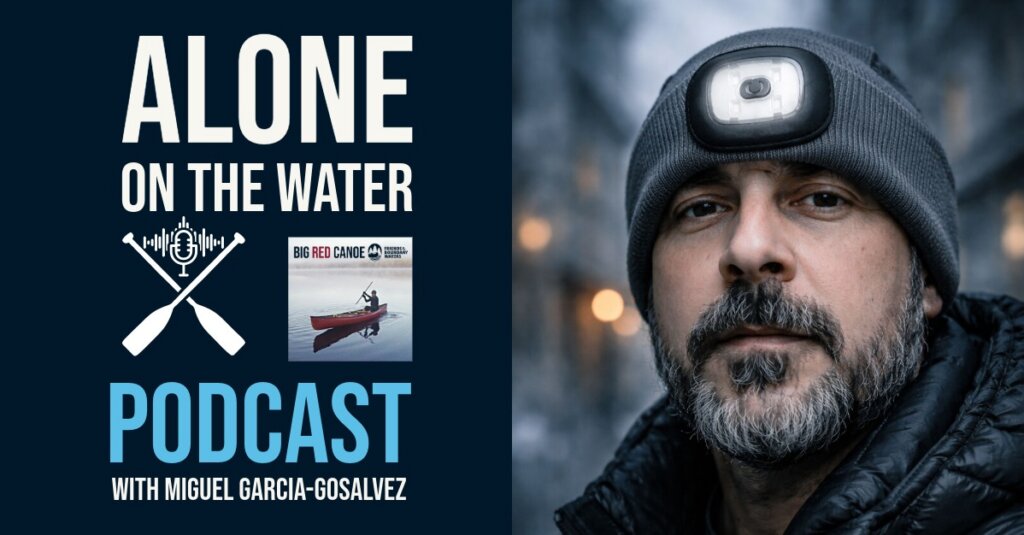
Solo camping in the Boundary Waters is its own thing. No partner, no safety net — just the lakes, the sky, and your own company. In this episode, we sit down with Miguel Garcia-Gosalvez, a solo canoeist who was born in Spain, fell in love with wild places as a boy in Europe, and found his deepest connection to wilderness in the Boundary Waters.
Miguel has spent years paddling alone, and he’s recently begun writing about it at mycanoelife.com — putting language to the feelings solo campers know but rarely talk about. Together, host Dave Meier and Miguel explore what solitude in wild places actually does for us: the stillness, the clarity, and the parts of ourselves we only meet when no one else is around. We also reflect on a hopeful moment for the wilderness, as entry points reopen following this summer’s wildfires. Whether you’ve done a dozen solo trips or never left the group campsite, this conversation might change how you think about being alone on the water.
Transcript
Miguel Garcia-Gosalvez: Looking for time to find peace I don’t think anyone needs to paddle alone into the wilderness to find that. But I think everyone needs some version of it, some space, some silence, some distance from the noise, right?
Dave Meier: Welcome to Big Red Canoe, the podcast from Friends of the Boundary Waters Wilderness, where we introduce you to captivating people and intriguing stories from America’s Treasured Wilderness. I’m Dave Meier. Grab a paddle and hop on in.
(Theme Music)
Before we get started today, I want to take a moment to acknowledge the wildfires that have been burning in the Boundary Waters in Quetico. It’s been a hard stretch. Closures across the Boundary Waters, evacuations, smoke in communities, and a lot of uncertainty. But thanks to the firefighters who’ve worked around the clock and some much-needed rain, those fires are coming under control, and the Superior National Forest continues to reopen Boundary Waters entry points that were temporarily closed.
That’s great news for paddlers, it’s great news for businesses up north, and it’s really good news for something deeper too, everything the wilderness gives us when we’re in it. That wilderness is behind everything we do at Friends of the Boundary Waters, and when you find yourself alone there, that experience gets somehow amplified.
No one around, no safety net, just the lakes and the sky and your own company. but then, when you can be with it for a while, something profound might open up, a doorway that the noise of ordinary life usually keeps closed. My guest today has spent a lot of time alone on the water, and he keeps going back.
Miguel Garcia Gosalves was born in Spain and fell in love with wild places as a boy in Europe. When he came to the United States, he found his way to a canoe, then to the Boundary Waters, and then to solo travel, and along the way, solitude became something he seeks out deliberately and something he’s learned to name.
English may be his second language, but the way he talks about wilderness is articulate, profound, and deeply moving. He puts words to things that only drift through my mind on my own trips, like wisps of clouds that are there for a moment and then dissipate. Miguel has been noticing and writing these things down at mycanoelife.com, mapping the psychological terrain of what this practice actually does for us, and today he’s gonna reveal for us some of what he’s uncovered about solo canoe camping, solitude, and what the wilderness does for our minds.
Miguel, welcome to the show.
Miguel Garcia-Gosalves: Thank you, Dave. I’m glad to be here
Dave Meier: I know you’ve been thinking about this year’s trips. When you push away from the shore alone on that first lake or river, going through your mind in that first moment?
Miguel Garcia-Gosalves: Excited, I’m nervous, but also kind of always a bit scared. It’s like I take a deep breath and I say to myself, “Here we are,” and I start paddling. It’s a reflection moment. Sometimes it takes me just the moment of getting into the canoe and pushing away it take me a few minutes to relax and try to say, “Okay, here we go.
It’s what I’ve been looking for.” But it takes a f- it takes a bit to disconnect, and we can talk more about it, but it takes a few days to completely settle my mind into what I’m doing right now w- when I get into the water
Dave Meier: Yeah, I think that can be true on a lot of trips. You’re pushing, you’re trying to get everything taken care of, you’re trying to make sure you’ve remembered everything and you’re trying to get on the water, to get that first sight. And then it takes a little while to, to s- to settle into the trip.
You’re finally there, you’ve gotten there, and then the trip can unfold from there
Miguel Garcia-Gosalves: When I push the canoe is when I start kinda like feeling that there is no one in the boat, no one on shore waiting. It’s just you on the water and whatever is ahead. And usually my hands are shaking at that moment, and it’s not just from the cold, but if you wanna call it from the weight of the decision, right?
Because pushing solo is … i, call it is a kind of commitment. There’s no one to defer to, no one to share any blame if something goes wrong, a- and no one to carry the extra weight. A- and I mean that in every sense, right? I- in … Not just in the sense that you have to carry the canoe on your back and everything, but also everything else that you carry with you, you cannot share that weight.
You carry everything with you
Dave Meier: Yeah, it’s all on your shoulders however the trip’s gonna go. in some ways that means you could take a different path. You could follow the plan. You only have to answer to yourself. but that must be a lonely feeling too
Miguel Garcia-Gosalves: at the beginning you feel like is this the right thing to do? Because then very soon you realize that kind of the wind doesn’t care about your schedule, the day doesn’t respond to your preferences, the weather doesn’t negotiate anything.
And every decision at that moment, your route, your timing, which camber you’re gonna stay, which risks are you willing to take, have immediate consequences. And I can feel that kind of responsibility. I can feel it in my arms, I can feel it in my back, I can feel it in the kno- in my stomach, when the sky turns dark much faster than I expected.
And at that time you realize that you are on your own. And it takes a while to, to get out of that moment. … That, that kind of directness, the first few time, it was terrifying. But at the same time it was the most alive that I have felt in many years. Like that first time I went alone and I realized that everything was on me, it was again, terrifying, but also made me that everything was on me and I could do this.
And from that moment on, I go multiple times a year. That is a, it’s part of my ritual. I need it. It helps me in many ways, not just when I’m there, but also when I’m back at home
Dave Meier: you have a solo trip scheduled for this year coming up?
Miguel Garcia-Gosalves: I have already three scheduled solo trips. early May, as soon as the ice is out. I like also going late in the fall. early in the season or late in the season the bugs are gone.
But also is, it’s very different moments in time. I mean, The days are getting longer in the spring, the days are getting shorter in the fall. The colors in the fall are amazing. And then I may go a couple of more times with my kids or with my kids’ friends. I like going solo, but I like going also with other people. It’s two differing experiences.
I enjoy both. But going solo is something that I really need for myself to, to help me to go through the whole year
Dave Meier: You didn’t grow up with the BWCA in your backyard. Where did you come from and how did you find your way here?
Miguel Garcia-Gosalves: I was born and grew up in the southeast of Spain, I was, like, about half an hour away from the Mediterranean in the interior, warm and dry. Think more like, Arizona or New Mexico k- that kind of landscape. And I always enjoy the hiking and going into the mountains, mostly by myself. I also was, as a kid, part of the Scouts, and I used to go with groups. But I really enjoyed going alone into the mountains and sitting down and spend time looking at the horizon, looking for animals and trying to see wildlife. But never in the water. I didn’t … I don’t think I never got into a canoe until my 40s. But for multiple reasons in life, I went to school in Barcelona, and then I met who is now my wife, and she was from the US. And then after we live in Spain for a number of years and we decided to move to the US, so we live in the Washington, DC area for a number of years.
And then to Madison, Wisconsin, which is where I live. And this is where I’ve been since. And a few years ago, I was introduced by a friend of mine to the Boundary Waters, and I fall in love, and I decided that I wanted to try to go there just by myself, and I’ve been doing that since
Dave Meier: How long was it between the first time you went uh, with a friend and then b- until you went solo?
Miguel Garcia-Gosalves: I went with a friend in September. It was, like, the fall, the beginning of the fall, late September, I thought it was something that I needed to go with someone who knew the area and knew the landscape better than just going for the first time by myself.
So I went with him and then the next spring in May, I went for the first time solo. And I realized that I wanted to go solo because when I went with my friend I was more inexperienced than him, so I … He was at the back, I was at the front, and many times in this trip that we did for several days, and we put a lot of miles on that trip he used to tell me, “Talk to me.”
And I said, “What do you mean?” I was kinda fascinated. I was just paddling, and I got into that rhythm of paddling that it was like a … It was like a relax. I was doing mindfulness. I was paddling, and I was enjoying the landscape so much and so into what I was seeing and listening, that he complained that I didn’t talk too much, that I was too quiet.
And then I realized that there was something there that I was enjoying, I didn’t need to be on Twitter, I didn’t need to be on Facebook, I didn’t need to be posting thing.
I didn’t need to show anyone where I was or what I was doing. I was enjoying that, but I was enjoying that just for myself. So I realized at that moment that, yes, as much as I enjoy going with other people, which I do, I also really realized that going alone will be something that I needed to try and enjoy, and it’s been hard many times don’t get me wrong.
And there are ups and downs every trip when I go by myself, but I think the overall result is positive, and that’s why I keep going back.
Dave Meier: Yeah. you described a specific moment where you kinda, it seemed like you made mind, body, landscape, spirit connection with the Boundary Waters and the process of, canoeing. is that specific moment where you realized it, the moment you knew this was for you?
And did you find any similar moments uh, when you started solo camping that were different? Like where
Miguel Garcia-Gosalves: Yeah, I think something shifted especially when you are just by yourself, you, you don’t have that pressure of having to listen to someone or maintaining a conversation. What I found is that going and paddling, I would say for hours, that kind of repetition of the stroke creates a rhythm, and that rhythm creates a kind of mental space that I found very fulfilling.
And it’s not like the wilderness was giving me any answers to anything. It was more like being alone and being there removed the noise so I can hear my own answers. I can hear myself, which usually in my day-to-day life I’m not, I’m too busy. I’m I’m in meetings. I work in a large organization that is always dealing with meetings, with problems, with emails.
Everything is urgent. Everything is for just today, and being able to disconnect from that It opened my mind to think a bit different of what I was looking for. And I realized when I was … The first time I was there by myself, especially after a few days I realized that I have everything that I needed right at that moment.
Maybe it wasn’t everything that I wanted, but it was everything that I needed at that moment in time. And that was like a revelation to me at that moment
Dave Meier: That’s profound.
Miguel Garcia-Gosalves: Oh, thank you. I don’t look at that way. I look like it’s not confidence in myself. I think it’s a b- a bit deeper than that. It’s you wanna call it self-trust. I- it becomes more like quiet knowledge that you can assess a situation on your own, make a decision maybe with incomplete information, and just because it’s just yourself, you have to live with the consequences.
And that’s not usually what happen in my day-to-day life, right? I live in a world where I’ve gotten very good at buffering myself from consequences. I work, as I mentioned, in a big organization, so I’m used to delegate and used to defer and used to maintain the comfortable illusion that my choices didn’t really matter or that someone else will handle the fallout.
But being alone and being at the boundary waters by myself, that, that was stripped away in 45 minutes when you realize that every decision is on your own. Do you wanna paddle more? Do you wanna go to the next campsite because the first one you don’t like it? You think the wind is not gonna change, or you think the weather is gonna be good?
right or wrong, you will pay the consequences or you will enjoy the benefits but there is no one you can blame It’s all on your own, and that makes you feel … It makes me feel very alive at that moment
Dave Meier: I know what, what you’re saying. those are some of the feelings I’ve, I remember on my first camping trips as well, … Or solo trips. I’ve so- I’ve spent time solo hiking and backpacking, and I’ve, I still have yet to go to the Boundary Waters by myself.
But yeah, it’s a shift, if you’re with other people, then you’re still working within that framework. And then if that is gone, there is this true feeling of being alone and being responsible for what happens. And that can be really freeing, and you can shift what you’re doing into a different activity right there and then.
You can’t wait for somebody else to act. You have to make a decision to act yourself if something changes and you have to respond to something like wind coming up, a storm a threat anything like that
Miguel Garcia-Gosalves: W- another way I look at it is like when you go on a solo trip it really happens a compression. Your life narrows quite a bit, I would say dramatically. And f- at first it feels like a loss, but then you realize that basically when you are out there far from anyone, everything reduces basically to four or five things.
You have clean water to drink, you have sufficient calories, you may have a dry shelter, either a tent or a hammock or a tarp if it rains. You have reliable gear, like a nice canoe. You have good clothing if needed and sound judgment. That’s it. Everything else falls away. Your job, your title, your inbox, your social media, that argument that you had with someone last Tuesday, all of that is gone.
And then you start noticing that those things are missing. But the hardest part is when you realize that noticing that is that because you don’t really miss it, and then you realize that things could be much easier. At home I was chosen to carry all that extra weight, the noise, the urgency, the kids, the constant pressure to optimize and perform and be seen.
And then I realized that all of that I don’t need it. And especially when you are by yourself, not only that you don’t need it, is that it doesn’t really matter. It’s not gonna make a difference if you don’t have … Again, if you don’t have water to drink, or if you are cold, or if you are wet, or you don’t have enough calories, all these other things don’t really matter.
But those five things really make the difference. And that kind of simplicity I found it a very good exercise to do periodically, and some … … From time to time I need to go back to the wilderness to refresh maybe that’s why I keep going back. I it’s part of a routine now that I need to do, and it helps me to come back recharged.
Let’s put it that way
Dave Meier: I feel like you’ve brought us to this kind of idealized place of mindfulness where you’re interacting with the landscape, just you. and there’s something romantic about that. And is that what a solo trip actually looks like? Or can you always spend time in that mental place?
Or there other things that are the reality of being alone, the bugs and the rain, maybe a little loneliness that creep in that you have to, that you have to deal with where, you have a different feeling?
Miguel Garcia-Gosalves: that kind of romanticism is, it’s kinda like a first step, if you wanna call it. I think there is a lot more profound things that happen after. you can think about it like first, like identity exploration, … When you are free from your social roles, your auth- your authentic preferences, your values, your aspirations start to emerge.
And then you realize maybe what are your genuine interests versus the things that you are doing because they are important for your job or for your family. You start thinking about what are your authentic personality traits. And with that you start having a clarification of values.
When you are alone, you have more time to reflect, and that start providing clarity on what truly matters in your life, in your relationships, in your careers. And then after a few days, and again, it has to be a few days, it’s not … it doesn’t happen in one day or two. It’s what I call some sort of like a inner wisdom access.
You start looking things a bit different. When you have silence for a while, that allows you to access some sort of intuitive knowledge that you have that maybe is hidden because of your daily noise and the, and your daily routines. And I realize that I’m better in, in doing decision makings, making in a more intuitive way.
I’m better at creative problem-solving ideas. I start gathering some sort of emotional intelligence, if you want. I know it sounds weird, but I think going solo for a few days is like a trip, right? It’s a journey of transformation that needs to happen in several days. And I’m happy to talk a bit more about it.
And I didn’t know any of this. I going through now multiple trips alone, I been reflecting all the phases I went through, , and it turns out that this has been very … There’s a lot of publications and research about this, about, about all these phases.
And it’s really transformational and I recommend it to everybody to, to at least give it a try. I don’t say this is for everybody, but going through those phases and experience it firsthand it’s not wasted time. Let’s put it that way
Dave Meier: Let’s talk about that a little bit because I was thinking about what you would encounter, physically. You’re out there alone. How do you handle the canoe? How do you set things up by yourself? How do you overcome a storm or things that might come up on your trip? And what you’re saying is that’s all kinda wallpaper. You will intuitively solve those challenges as they come up, and then really for you, the adventure is a mental or s- psychological adventure or spiritual adventure
Miguel Garcia-Gosalves: Yeah. That’s a good way of putting it. There is still some sort of I, what I call it first few days or maybe the first day or even the first 24 hours is what I call like initial discomfort, anxiety, restlessness, kind of desire to return to your familiar environments, wondering why are you doing this.
But that is normal and indicates the beginning of some sort of adjustment to solitude. You start experiencing some sort of withdrawal from your phone from the social media. the first night I never sleep well. Although my body is there, my mind is still at work on my problems and my things that I was doing or I
things that I needed to finish. It takes a while to really disconnect. Again, my body is already out in the wilderness, my, my mind is still not disconnected. It takes at least a day or so. And then I’m going into what I call more some sort of like sensory awakening, if you want, where your curiosity strengthens.
You start looking at the landscape in a bit different way. You start listening things that maybe you didn’t realize. I can listen to the wind, I can see where the wind is going, I can feel the wind in my back or i- or in my face. I can see the water, how it’s moving, and some sort of a appreciation of natural beauty, a start beginning some sort of shift from anxiety to wondering. It’s okay, now in here I’m enjoying it. I’m seeing things that I never noticed. I’m hearing things that I never realized they were there. And some people say w- when they do are in that silence, there is a lot of things going on.
Even though it’s silence to a certain degree, I can hear and feel a lot of things, and that is what I call the sensory awakening that happens after the first day when you are probably in day two or day three when you start feeling that, that way. And then after that, if you are there for a bit longer, usually after day two or day three It’s I call it like a some sort of like cathartic release.
It’s if you wanna call it some more of deeper introspection in the sense that I start processing some sort of grief, anger, or even fears. I have some memories and emotions surface more naturally. Uh, Both my parents are now gone, so I
when I’m alone for a few days, I feel like they’re closer. And
I know it sounds crazy, but I’ve cried many times when I’ve been alone. And it’s … I feel com- a bit uncomfortable saying this, but it make me appreciate more my family, my, my parents my kids.
Those memories and those emotions surface naturally. And I think it’s a good thing because in my daily life I try to hide all of that, right? . It’s in- increased emotional intensity, but – in a good way.
And then the more time I spend alone after all … going through all these up and downs, if you wanna call it, it’s what I call more like integration and transformations, I feel everything is more clear in my mind. I feel like a renewed purpose and a profound peace.
When I’m there for a few days, I s- feel more like a sense of completeness and integration. I have better, maybe better insights of where I gonna go with my life. I have totally renewal energy and purpose, and also a deep appreciation of both solitude, but also of connections. In the sense that, and we can talk a bit more, because this is not just going alone, but also it’s what happens when you go back, right?
To, to your routine, and to your daily life, and to your family, and to your kids, and to your work, and to every day. I think it’s life changing. And it has provoked on myself like a lasting impact that, that I keep going back. That’s why I keep going back every year multiple times.
Dave Meier: It sounds like you get a lot of value out of this personally and thinking especially about your family and who you are in the world. And you’re, uh, in the wilderness and you’re setting everything aside and realizing that in the wilderness you’ve got everything you need, they’re not there.
So do they understand that uh, you don’t need them? Or do they understand that you need this time where that space is carved out for yourself and then you can come back to them?
Miguel Garcia-Gosalves: I think they understand now that I need this, but also I think, a- and I don’t wanna talk on their behalf, but I think that they realize that this helps me, and when I come back, I’m a better dad or a better husband or a better boss or a better manager. Just a better person, right? Because I think
Because solitude becomes a mirror. And unlike the social world, the wilderness doesn’t flatter you. It shows exactly who you are, the good parts and the part that you’ve been avoiding. And that’s the work. It’s not always comfortable, but it is always honest, right? When you come back, you have to answer. You have to live with it.
And over time your judgment gets a bit sharper. When I’m in the water, I learn to read the conditions. Not only in the water, not just the wind and the weather, but also the conditions of myself. And I think that skill is transferable. So that’s when I go back, the world is exactly the same, but I’m not, right?
After my longer trips, I go back to the grocery store and I feel a bit overwhelmed by the sheer volume of choices that are there. I look at my calendar and wonder how I let it get so full of things that don’t really actually matter to me.
Extended time in the wilderness produce a quiet but powerful value shift. Material concerns tend to lose their grip. Status to a certain degree becomes irrelevant. You start basically asking different questions, right? Where do I wanna invest my time? Who truly matters? What am I optimizing for?
What kind of person am I becoming? And these aren’t, these are not new questions, But they become urgent after the wilderness in a way that they were never before. When I come back, I start asking these questions, and that what make me realize that I wanna spend more time with my kids.
When I sit down with them, I put my phone away. We have dinner and the TV’s off, and we can sit we don’t eat everyone at different time. We sat down for dinner, and we have meaningful conversations. And- That, I think that, that has a lot of value. I have better conversations with my wife.
I enjoy more the time that I, that we are together. After a while, I go back to like, sometimes I’m there, but I’m not present. My mind is somewhere else. I can be physically there but be totally away. And going these solo trips help me to focus. That really be there when they need me listen more and talk less.
This kind of mindset diffuses over time. That’s why I need to go back and keep doing this routine because it helps me to come back again and start all over
Dave Meier: Yeah, you’ve gotta fill your cup. are there any stories that come to mind where you’ve come back and made a change right away or in the first week?…
Miguel Garcia-Gosalves: It sounds like a small thing, but I don’t need to be checking my phone all the time. I can leave my phone in another room, and I don’t need to be checking it.
And if there is a ping, it can wait. Before there was a ping, and I will get up of the table and see who is calling or what is happening, and I leave my kids and my wife there having dinner. Now I, when I come back, I realize all those things can wait, but the time that I can spend with them, be more present is more important.
And also do realize how things change, right? I … And maybe that’s because I moved to this country 30 years ago, and for the last 30 years, all my family are in Spain, so I would only see them few times a year. I really tend to value more the time that we were together, and I think all of that is because I spend time alone and have time to reflect and going through all of these phases that I was mentioning, that It’s not how much time you spend on doing something, but the quality of that time.
It’s better time. Let’s put it that way. I don’t know if I’m expressing myself very clearly. It’s hard to explain how I feel, but I hope that everybody can feel it
Speaker 7: Yes, I can feel it. We’re gonna take a short break here, and we’ll be right back
Speaker: With over 1,200 lakes and hundreds of miles of trails, it’s no wonder that people spend a lifetime exploring the Boundary Waters. With so many possibilities, it can be daunting to figure out where to go. Whether you seek adventure, solitude, or want to reconnect with others, Friends of the Boundary Waters has extensive online resources to help you get the most out of your Boundary Waters experience.
Visit www.friends-bwca.org/explore for more information.
Speaker 9: I’m back with Miguel Garcia Gonsalves. Going back to the Boundary Waters here, when you wake up in the tent, what’s your first thought that goes through your head? And, and then how do you find within camp activities or the day’s travel that you have, how do you fit in this time for reflection in between?
Miguel Garcia-Gosalves: What I try to do as a general rule, and that doesn’t always work that way, is I spend probably half of the day or maybe a bit more paddling, moving from one place to the other And then usually early afternoon, 2:00, 3:00 PM I decided that I find a camp that I like or something that I already had in mind where I wanted to spend the night.
And then I stop there, either set up my tent or my hammock, have a coffee, maybe gather some firewood. But I like always every day spending some time just looking at the water, looking at the sunset, relaxing. I tend to read a lot when I go into these trips. The first few trips I used to spend a lot of time fishing.
Now I, I don’t even do that. I may fish for an hour, for 45 minutes. Sometimes it’s just to get something for dinner, but not necessarily. The last couple of trips I didn’t even fish at all. I didn’t even bring the rod I wanted to have time to do nothing. Meaning I spent hours looking at the sunset, looking at the horizon, looking at the clouds, looking at the weather, looking at the lake, the wind, the birds, reading.
I like writing, too, taking some notes, remembering things It’s like looking for time to find peace with my mind and with myself. And and to be honest, th- this … I don’t think anyone needs to paddle alone into the wilderness to find that, but I think everyone needs some version of it, some space, some silence, some distance from the noise, right?
Because that kind of … the daily noise is relentless. It- it’s designed to keep us distracted and reactive, and it’s hard to step away from it, both deliberately and physically. But when you are by yourself, it- it’s that moment it … I find very peaceful. I like just sitting down, making a cup of coffee, and keep the mug of coffee, the cup in my hands, and feeling that warm in my hands while I’m feeling the cold air in my face, and looking at beautiful sunset, or just looking a storm that is coming.
I find peace in myself. I appreciate every minute of it. When I walk in, in the city or I live in Madison, I don’t realize about where the wind is coming or going. I don’t hear the birds.
But when I’m there I can feel all of that. It’s like I’m a lot more awake, if you wanna call it. And I don’t need to be moving all the time. Some days if the weather is gonna be bad or I think, or it’s too windy I try not to have like, a closed itinerary that I have to do. I’m, I’m open-minded. I think that’s important.
You have to be be able to adapt and go with the flow and don’t get upset about it. So I in … I try to enjoy every moment, whatever it is. And it can be just paddling. I can paddle for hours. That kind of routine movement is like mindfulness to me. That kind of clear noise of the paddle going into the water, and that pattern moving, I find it very, again, relaxing, but also I’m feeling everything, thinking about everything that I have in life I appreciate it a lot more, everything that I’ve got.
Even the bad things that happen to me, Don’t put it as a bad thing that happened to me, but more like another experience that I went through, what I learned about it. Is you need to find that kind of space and away from the daily noise to feel that way. It’s hard to explain, and that’s why I encourage people to try.
And again, doesn’t mean you have to go alone for a week or two weeks in the wilderness, but find some space where you have some silence and some distance from the daily noise
Dave Meier: Yeah, I think there are different degrees of what you can do, even if it’s just taking a walk or paddling somewhere on your local lake by yourself but I think what you’re talking about as far as, having a hard time putting down your phone and the drama of your calendar and all the places you have to be and all the spots you have to hit at first when you go on a trip, I feel like you’re addicted to that a little bit, and it’s like a fight or a flight feeling that it takes a while for that to melt away. And when you don’t have that stimulation, your brain is feeling like something is missing. I think it’s a little bit disconcerting when you first get started.
Miguel Garcia-Gosalves: That’s … W- when you paddle alone across open water and you finally at the end of the day make it safely to camp, when you have re- read the wind right, when you have chosen a route that it was good, when you have timed the crossing of that big lake properly, you build a fire, you set up your shelter before the rain, you start building something that is hard to name, but it’s also impossible to fake.
What I learned is that I can sit with discomfort and at the same time move forward anyway.
I can be afraid and at s- at the same time I can still act. That I can make a mistake, I can adjust, and I can keep going. And I think a lot of us again, including myself, we have that muscle at- atrophy. In modern life, we tend to outsource a lot of judgment. We follow protocols. We defer to experts. We avoid situations where we have to make real decisions with real stakes. But when you are alone i- in the Boundary Waters or any other wilderness or anywhere else that you are by yourself, you are not allowed to do that. Every day, multiple times a day, you face questions that matter.
And I think being alone and being in, again, in the Boundary Waters or anywhere else, you cannot delegate any of those things. Everything is on your own, for the good or for the bad. And independently if it goes well or it goes bad, it makes me feel really alive, and it makes me feel that I can make these things, and it really makes me feel better.
And not only when I’m there but also when I come back because I appreciate more what I have. I appreciate more everything that I have around me that sometimes I take it for granted. And it’s a good feeling, to be honest
Dave Meier: And I’m appreciating you, Miguel, because you’re thinking about these things. We don’t often pause enough to think about what we’re experiencing. And you’ve done that, and you’ve written about it also you’ve done some research right, about some of these phases of being alone
and so you’ve noticed them in yourself, and then you’ve also looked to science what have you found And what came first the writing or the research?
Miguel Garcia-Gosalves: First it comes the writing because the, some of the writing I start when I’m there just by myself. And but then I realize that- There is a lot of psychology into this, right? And that’s when I started looking more into research. And then I realized that the psychology field has done a lot of research about this.
There, there is good things about going solo in the sense that kind of helps you confronting fear, but also building resilience, and I think that’s useful in, on, in all aspects of our life.
But also at the same time, and this is what I was mentioning about my parents, I I confront more mortality and meanings. Confronting fragility leads to a deeper appreciation for life, right? Realizing that my parents are gone, and I feel at some point that I was even a- as crazy as it might sound, like being able closer to them when I was there and talking to them in a way that maybe I wasn’t because I spent 30 years away.
Navigating solo , builds personal confidence. But also it helps me to improve my adaptability, like managing unpredictable conditions, either weather, rain, you get wet, or you don’t have enough food.
It it develop problem-solving, right? And at the same time, it also helps you have stronger emotional regulation. Processing intense emotions alone improves handling of life stressors. When you are solo and you have intense emotions you become better at managing them, right?
And also making critical decisions alone develops your trust and your personal judgment, and those can be things as the wind is picking up, should I cross this big lake or not? Or it’s getting dark, should I push for a m- one more mile or two or just stop in this camp that I hate it or it looks terrible but- is the best decision to make.
It’s not just the decisions that you make while you are there, but also how you approach decisions in your regular life.
And this has been very well studied by psychologists, and there is a lot of bi- bibliography about all these phases and what the minds goes through.
And I learned all of this after the fact because I was experiencing some of these things, but I didn’t know how to put words to how I was feeling. And reading about all these things helped me to understand better the phases that I go through, but also it helps me to understand that I’m going through those phases so I’m not as scared of them.
I know that the first day or the first two days I’m gonna feel uncomfortable. I’m not gonna sleep well. I’m gonna miss a lot of things. But then I know that’s a phase that later it will pass, and it does. And by the last few days, I sleep better there than anywhere else, right? And it helps me to keep going back because I know what I’m gonna experience, and I know what the value is gonna be at the end. And I love it.
Dave Meier: Yeah. Me too, and it makes me wanna go uh, solo camping right now. Is there anything in the scientific research that you did that you found, that surprised you or you said, “Aha,” that’s right, like now that I’ve read that I think back and I, I recognize that in, in my experience?
Miguel Garcia-Gosalves: The research has, which I didn’t know. They say basically when you go into the wilderness alone, there is a 87% reduction in cortisol and 65% decrease in anxiety. And this is from peer review psychology study. This is not like speculation.
This has been very well studied. So there is a stress reduction and mental restoration. They say when you go alone, you improve 40% your quality of your sleep, 50% increase in positive emotions. So basically going a- alone restores to a certain degree your mental health and is for multiple reasons, right?
The digital disconnection, the, fascination with nature, the profound silence the natural light and rhythms. You go to sleep when it gets dark and you get up when it … when is the day, which we don’t tend to do that, right? All of those things improve, is improve the sleep quality.
But also like the profound silence. Silence is not just silence. It’s … When you are in profound silence in the nature, there’s a lot of noises going around, but that allows to suppress a s- specific thoughts and emotions and some other things surface more safely. You can feel sad, but it’s an emotion that is safe and there’s nothing wrong from feeling sad at some moments.
And again, the … this fascination with nature, it captivates your attention. It restores kind of cognitive functions that, again, you can feel the wind, you can hear the birds. You know the … where the wind is coming from. You can feel the humidity if it’s gonna rain. All those things, all those senses I don’t notice when I’m in my regular day.
But when I’m there, especially after a couple of days, I start feeling all those things. And I think is … it is … it realizes our potential, right? The digital disconnection I think it, when you are not overloaded with information it relax your nervous system and you feel your anxiety levels go down. Because you are not constantly bombarded with inputs.
It’s more … It’s a bit more relaxed environment and you can feel things that you don’t feel otherwise
Dave Meier: Yeah. I feel like you’ve you do a good job of putting this into words. So, You started a blog, mycanoelife.com.
I was wondering if maybe you’d be willing to read that for us.
Miguel Garcia-Gosalves: It’s about the sensory expansion that I was mentioning, right? Say, “Without conversation, the senses sharpen. The paddle entering the lake makes a clear sound. Wind direction matters. A loon call feels close and precise. Light in the early morning has weight to it.
Birds begin to approach, come quietly. I sit still and let them move as they wish. There’s no need to interrupt the moment.” And that’s my routine every morning. I set up, I get up, sit down, don’t make any noise, have my coffee, and every time the birds start coming, and they get close, and they go with their life, and they don’t mind that I’m there.
They are not scared. They don’t fly away. And again, it’s … No need to interrupt that moment. I can spend two hours just sitting there looking at the water and looking at the birds and listening to the leaves and the trees and the wind, and I find pi- peace with myself
Dave Meier: And that comes through to me when I read your writing, , it’s the things that you choose to focus on are the things that I recognize from when I’m in the wilderness for a while, and you mentioned You do writing in the Boundary Waters. is it written in the Boundary Waters? Is it written at home? And who are you writing for?
Miguel Garcia-Gosalves: It’s both written in the boundary waters, sometimes written at home, sometimes it started in the boundary waters, I finish at home, a bit of everything. But I started this as a personal logbook, like a … more like a place to record what I learn out there, the simplicity of life on the water, the lessons that solitude and wilderness teach when you’re finally quiet enough to listen.
I don’t advertise this. I started doing this more for myself. I never expected anyone else to read it, but some people did, and some people wrote to me, and some of those messages that I got made me realize that I wasn’t the only one feeling what I feel out there.
Dave Meier: Yes
Miguel Garcia-Gosalves: I’m not gonna teach anything to anyone. I’m not gonna show any route or review any piece of gear. what I’m trying to do is tell people what solo canoeing has actually done for me inside, how it changed the way I see my life, and I want to be honest about it, even the parts that are sometimes uncomfortable.
I found important to write how I feel, and sometimes I like just going back and read it to remind myself what are the right things that I wanna do, and sometimes I need to remind myself because I tend to forget sometimes, and I tend to go back to my routine.
It’s hard to escape our daily routines. So being able to re-read those things, it helps me to sync again my compass, if you wanna call it, in the right direction
Dave Meier: Talking to you has inspired me uh, It’s been m- many years since I solo camped, but I’m looking forward to doing it again this year. For someone who’s paddled with groups but never alone, what are some things that they might have to do to get out by themselves and think about?
to get out on a solo trip?
Miguel Garcia-Gosalves: What I would recommend is at least give it a try. The important thing is to go solo doesn’t mean you have to go far. So if you’ve never done it and you don’t wanna go for a week or for two weeks alone in the Boundary Waters you don’t have to. You can start going one night away. You can start camping outside in your backyard if you want, right?
Just to get the feeling of what it means. What it means especially if it is cold or if it rains. I think you need several days to go through those phases that we were talking before, because you need some time. If you go for the first time solo, maybe you don’t wanna go to a place where you’ve never been. It’s something that you’ve been before, maybe with a group, so it’s familiar.
But I wanna make sure is people realize you can feel two ways. You can feel lonely or you can feel the solitude. And what I always said is and this is not my quote, this is written by many people, is “Loneliness is the pain of being alone when you don’t wanna be, and solitude is the gift of being alone when you choose to be.”
If you go just one time you may feel lonely, and you may need to go more than once to move from loneliness to solitude.
, You go through phases, and that those phases can be a few days or a lot of days, it depends on everybody.
But going from this kind of anxiety at the beginning to find peacefulness by the end i- is a process that goes through, I would say, at least three, four days. So if you just go by one day, you may not get the full benefits of it because you’re not gonna be able to disconnect enough, and you’re gonna maybe feel uncomfortable without realizing the things that are the good things of being alone, right?
So I encourage people to try.
Dave Meier: fun.
Miguel Garcia-Gosalves: Yeah, that’s why I encourage people to try more than once and again, it’s not a matter of going far or in the real wilderness, but it’s it’s a matter of experiences that kind of like being alone, being away from the noise, being away from the … disconnect from the digital life.
It’s those things, again, don’t need to be completely in the far remote wilderness. It can be closer than that as long as you are conscious about it. If you go one night somewhere nearby, don’t take your phone or take your phone but don’t use it, right? That kind of things. If you don’t disconnect then you don’t get the value of that.
You just get the discomfort of being in a tent or in, in a hammock if it is raining or it’s cold
Dave Meier: … And there are more and more places where your phone can be uh, connected, I think, in the boundary waters. I’ve accidentally found that out when I’ve been using it as a camera, and then all of a sudden a couple messages start popping up, that have come in while I’m gone.
I’m like, “Oh, no. I’m
Miguel Garcia-Gosalves: That’s unfortunate.
Dave Meier: Yeah.
Miguel Garcia-Gosalves: something I noticed too
Dave Meier: takes you out of it right away, and then you’re curious, and you wanna know what they are, so you look at them, and then it’s like, maybe I’ll see if there’s some weather coming,” you know? And all that stuff, you get right back into it.
It’s very addictive, and it’s very important to be intentional, I think, about that, like you say. so you also travel with groups like family groups or whoever, friends. how is a solo trip different from a group trip?
Can you get to some of these things you’re with a group? Or is it just completely different?
Miguel Garcia-Gosalves: I, I would say it’s harder to get to these things that we mentioned. It’s a different experience. It’s a different experience. I enjoy both things. Maybe I enjoy more being alone, but not because it’s better. It’s just because I look forward to it. Going with groups, yeah you maybe get away from the phones, but you have conversations.
It’s more time together. People tend either to feast or to play games or sit down and swimming and jumping into the water. There’s a lot more rituals about preparing dinner or preparing lunch and sitting around, building a fire and sitting everybody around, which I really enjoy. I think it’s fun, but it’s different.
And I enjoy going with my … I have this 18-year-old kid and a 20-year-old daughter, and sometimes I go with them and their friends, which they tend to want to ask me to take them, and it’s a great experience. We really have a great time, but it is not the same. And I don’t mean this in a bad way.
It’s just different experiences. Both have good things. I think the ca- the camaraderie the conversations, the laughing the sitting around preparing the f- the food. Either it’s something you feast and you eat it right there, and everybody contributes to that. Everybody helps carrying the stuff.
There is, there’s a lot of value into that, and there is a lot of close friendships and relationships that are built and strengthened through those. But it’s different from going alone. And again, nothing wrong with that. I enjoy both things, and I like doing both things, but I don’t get the same from each one
Dave Meier: I love going with groups too. I love going with people. I love going with my kids and my wife and my friends and I love introducing new people to the wilderness. And that’s something we talk about at Friends of the Boundary Waters. You know, That’s one way you can help protect the wilderness, by spreading the word and taking people out there.
But you’re right, I can see how that you wouldn’t necessarily be get, be able to get to this mental space that you’re talking about. For me, it’s, am, I’m sometimes worrying about are other people enjoying themselves? we working too hard? are the bugs biting too much? Are people enjoying the food that we planned and maybe spending more time on the food and trying to impress people with your favorite camping dish.
those kinds of things sometimes I would say getting in the way of removing those expectations that you’re talking about. What do you eat when you’re uh, solo camping? Just the bare minimum, or you said you didn’t even fish last time.
Miguel Garcia-Gosalves: This is something also that you learn over time, right? I started at the very beginning probably carrying too much food. And not just too much food, but too much of everything. So in fact, to the point that at the very beginning of my first solo trips, I have to do double portaging. I will have to carry my canoe, come back to get my bags because it was too heavy to carry everything.
Over time, I learned to the things that I really need, the th- the things that really make a difference and the things that didn’t. So I now travel pretty light. I can do … I can carry the canoe and my bag all in once, in one trip. I carry a lot of, those dry foods that you just put hot water, and that’s usually what I have for breakfast.
Some sort of oatmeal that you just put hot water. I carry a lot of coffee. I drink a lot of coffee. I like coffee. And for dinners, I also carry some of those dry food or soups and things like that. And I also carry jerky, beef jerky, things that don’t get spoil. Instead of carrying bread, I tend to carry more the typical tortillas because they last longer.
They don’t get bad for several days. But honestly, I would say that probably I eat less when I’m in the wilderness than I usually eat. I don’t need it. I think it’s more I need sufficient calories, but n- don’t need to eat a lot. I know some people enjoy preparing all meals and … sometimes if I fish I just get one, what I need for dinner. I don’t need to eat a lot. i’m from Spain, so I like manchego cheese and ham. Some things that don’t get spoiled, don’t need to be refrigerated. What I usually do is I count more or less the meals that I need for the days that I’m planning, and I may take additional food for one extra day just in case the weather is bad and I need to delay my out in one day.
But that’s another thing I came to appreciate. I feel less hungry even though I’m paddling and carrying all this weight. Just being there, I’m f- I’m feed in many different ways that it’s not just the food. Uh, don’t get me wrong, I need sufficient calories, but I don’t need 4,000 calories a day even though I’m paddling and carrying all the weight.
I need more the time to sit down and relax and enjoy soup that I just put water in it or an oatmeal that I just put water in it, I really appreciate every single scoop that I have, and I enjoy that time and the feeling of being out there and having food and being dry and feeling the wind and feel the quietness and listening to everything.
Maybe that’s why I can travel now pretty light. I mean,
I tend to put a lot of miles, but also because I travel light, that allows me to do that. If you carry a lot of things if I can and then the weather allows to do it, I move every day I look for routes that allow me to do s- different loops, so I go in and out from exactly the same entry point, but the in and out is not just going forward and then come back the same way. I can go around multiple lakes and do loops and find a way that gets me back to where I left my car, one thing that I tell people is some people plan their routes, and they have r- really everything decided in advance. I like to do some sort of planning, but allow myself a lot of flexibility. And not just because the weather can be bad or there’s a stormy day or very windy day, but also to feel how I feel.
If I feel like I don’t … I feel tired a particular day, and I don’t wanna jump four lakes and do six portages, okay, I will do half of that and that’s okay. I don’t need to get to a particular point a particular day. So I allow myself a lot of flexibility, which also reduces the stress but also reduces the risk because I’m not pushing to do something than when maybe the weather would recommend not to do otherwise.
Or if I feel very tired, I don’t wanna try to push myself too much, and be flexible but also be in peace with myself, meaning that if I don’t get to where I was planning to get today, there’s nothing wrong with that. That kind of flexibility I think it reduces anxiety, and also… But most important, it reduces taking unnecessary risk when, especially when you are by yourself
Dave Meier: Yeah. You wanna build that into your trips, and then you also you know, as a solo camper, do you think it’s important to ch- do you check in with your wife when you get home? Has she ever gotten uh, worried about you uh, that you haven’t been in touch?
Miguel Garcia-Gosalves: what I do is I carry one of those satellite communicators, and I turn on what is called tracking, so they can go to a map and see where I am, and so they can see where I’m moving. And usually at the end of the day, I send a text message saying, ” Everything is okay.” And I also use that kind of to get a bit of the weather forecast. But it’s not perfect, but at least I know if it’s gonna be for sure raining or it’s gonna be very windy. Helps me to plan a bit. But it’s … It … I carry one of those that only allows me to send text messages.
I cannot talk or send pictures or anything. I can send and receive text messages, and I can check the weather. And also, it’s it sends these breadcrumbs so they can see on a map how I am moving and where I am. And that’s been good enough. At this point they have gotten used to me being away and maybe communicating, if not every day, for sure every other day.
they know that I don’t take risks, and it has worked for them and for me.
It’s a good idea to have something in case there’s an emergency. Not just for you, but also to give peace of mind to your loved ones to know, for them to know that you are okay.
There’s no need to, for them to wondering if you are okay or not when you have the ability to tell them everything is okay. I got to where I wanted to get today, or I’ve already set a camp, everything is good. Even if it is just literally because these text messages are only for 140 characters, that’s, that makes a difference for them and for me
Dave Meier: I wanted to go back to growing up in Europe what does wilderness look like in Europe, and how’s that different from and the Boundary Waters?
And then in your opinion do you feel like it’s important to protect places like the Boundary Waters, here in the United States?
Miguel Garcia-Gosalves: I would say the main difference between Europe and here the wilderness are much bigger. I can go in the Boundary Waters and paddle for days, and there’s no cars. There’s some people, but I’ve gone sometimes for multiple days without seeing anybody.
In Europe, no matter where you go, the wilderness or the places where you can go, they are not as big, and you will see people. There’s nothing in Europe that is one million acres like the Boundary Waters. And if you count Quetico, it’s another million acres, plus all the Superior Forest that is around it.
There is nothing that size in Europe. There are places that are more wilderness and all that. You can go hiking for several days, but density of population is much higher than is here. And why I think it’s worth protecting the Boundary Waters, I mean- Because there is nothing like that. It’s e- even if we couldn’t go there because it’s so protected that they don’t allow people, just the fact that I know that there is a place like that where the water is crystal clear, where the wildlife can enjoy really the wildlife, where there is no pollution, where you can see the sky like you’ve never seen before, where you can see more stars than you even realize are out there when you are in the city.
Because all of that is worth protecting. I know what we are going through with this new law that they have passed that allows kind of potential mining, not inside the boundary waters, but just literally outside.
It, it, really hurts my heart because… Not because mining is not important or necessary, it’s just because there’s no way to do clean mining.
And some- somehow, some way that will pollute the water or it will increase the number of trucks and roads that need to be built around it, and it will distort what is t- what is today the wilderness. And that’s why we call the wilderness because it’s as untouched as it can be, right? As natural as it can be.
And only because of that, I think it’s worth protecting. But also I love protecting it because it’s a place where I have found
the peacefulness and the joy that I never found in many other places. It’s a, it has a special place in my heart. I also love the water and being able to jump through multiple lakes in a single day and being able to see the wildlife, the loons the beavers, the bears, the eagles, and be able to see them in their natural environment.
I, I think that for me is invaluable. So whatever we can do to protect that, I think is not enough.
Dave Meier: Yeah, I agree. And I can tell talking to you how valuable it is to you. Um, you said even if you couldn’t go there, but the beauty is you can go there, and you do go there, and you do use it, and you’ve shared with us these experiences that, that you’ve had, and hopefully that can guide others onto some solo trips of their own.
And if folks are interested, they can go to mycanoelife.com and read a little bit of your writing and get even more inspired in how they can appreciate this solo camping. I’m gonna go solo camping this year for the first time in a long time, and I’m gonna do just what you said. I’m gonna go to a lake where I’ve been before, where I’m not going too far, but just to have that experience and give it that first try, and then hopefully I can make that a part of my trips, uh, that I like to do.
Thanks so much for describing all this for us, Miguel. It’s been great to talk to you.
Miguel Garcia-Gosalves: no, thank you, Dave. And I really… i’ve been a supporter i- within my reach of the Friends of the Boundary Waters. I love what you guys do, and I hope you keep doing it. And I think this is a special place that we all love, and you do what you do because you love that place. And I only have words of gratitude for all the things that you guys do o- on behalf of all of us, and I think it is worth the fight
Dave Meier: Thank you for that, Miguel. Yes, we’re grateful to have supporters like you and everybody else who has supported us. It’s been really great to see so many people step up with recent threats that we’ve been talking about. We appreciate it, and it is great to be in this position where we have this great wilderness that we can talk about, share in, and work to protect.
Dave Meier: And thank you everyone for listening. If you enjoyed the show, please share it with a friend and leave us a rating wherever you get your podcasts. We’ll be covering a wide range of recreational topics this season, and we’ll meet some great personalities from the B W C A along the way.
So be sure to subscribe so you don’t miss a thing.
Dave Meier: And to become a member and support the Friends, visit friends bwca. org.
.
Dave Meier: Big Red Canoe is a presentation of Friends of the Boundary Waters Wilderness Original Music by Surge and the swell. I’m Dave Meier and we’ll see you next time on Big Red Canoe. And thank you everyone for listening If you enjoyed the show please
Speaker: 50 years ago, a group of friends met at a diner and began to organize a movement. They called themselves Friends of the Boundary Waters. Through grassroots organizing, they fought to make the Boundary Waters the protected wilderness it is today. For 50 years, we’ve defended the Boundary Waters. Our strength is in our members.
It is in you. To learn more and join this movement, please visit www.friends-bwca.org.
SUBSCRIBE
On the Friends of the Boundary Waters podcast, we bring together people who share a love of the incredible BWCA wilderness in Northeastern Minnesota. The podcast will features scientists, political figures and experts in outdoor recreation and wilderness skills to help you learn new facets of the Boundary Waters Canoe Area, the most visited wilderness in the United States.
Listen on Apple Podcasts Listen on Google Podcasts Listen on Amazon Music Listen on Spotify Listen on StitcherContinue Listening
Podcast: The Trail Finds You
The Superior Hiking Trail turns 40 this year. Three hundred miles of North Shore ridgeline, from the Wisconsin border…
Podcast: What’s Next for the BWCA?
H.J. Res. 140 is now federal law. Listen to this podcast to learn what Minnesota's strongest legal tools can still…
Podcast: Ordinary People, Extraordinary Wilderness
Minnesota author Jeff Krogstad talks wilderness thrillers, bear encounters, and human resilience set against the frozen Boundary Waters in winter…