Podcast: A Wilderness Beyond Sight
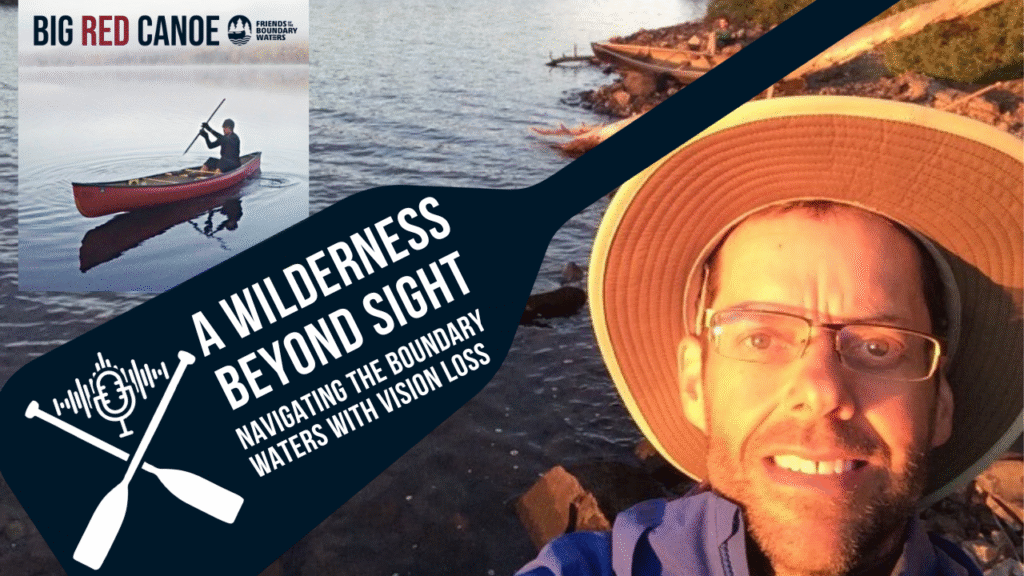
How do you navigate a challenging wilderness when you can’t even see it?
In this fascinating and deeply moving episode, we sit down with Kelly Carver, who has been paddling the Boundary Waters for over 40 years—including the past three decades since he became legally blind.
After being diagnosed with a degenerative eye disease following his first BWCA trip in 1982, Kelly refused to let vision loss stop him from experiencing the place where he says “part of his soul” resides.
Kelly takes us inside what it’s really like to navigate the Boundary Waters Canoe Area Wilderness without sight, from paddling across lakes to mentally mapping each campsite, then ultimately rising to the challenge of completing the epic 220-mile Border Route, which included traversing the legendary nine-mile Grand Portage by himself. He shares harrowing moments—a mysterious canoe flip, 40-mph winds on Knife Lake—and magical ones, like the fox standing three feet away that he never saw coming.
Through it all, Kelly reveals what it has meant to finally embrace the word “blind” after years of fighting it, and reminds us that the wilderness belongs to everyone willing to step outside their comfort zone.
Whether you’re facing your own challenges or simply want to experience the Boundary Waters through another viewpoint, Kelly’s story of determination and adaptation is almost certain to change how you think about what it truly means to experience the Boundary Waters Canoe Area Wilderness.

Contact Wilderness Inquiry about upcoming accessible trips.
Transcript
Kelly: I call myself blind. I am blind. Canoeing it’s kind of an equalizer.
I’m a solid paddler. and, My disability doesn’t figure in quite as much. And then when we start Portaging, that’s when it sort of snaps right back in.
Kelly: I call myself blind.
I am blind. Canoeing it’s kind of an equalizer.
I’m a solid paddler. and, My disability doesn’t figure in quite as much. And then when we start Portaging, that’s when it sort of snaps right back in.
INTRO: Welcome to Big Red Canoe, the podcast from Friends of the Boundary Waters Wilderness, where we introduce you to captivating people and intriguing stories from America’s Treasured Wilderness. I’m Dave Meier. Grab a paddle and hop on in.
Dave: . I’m really excited for you to meet today’s guest, Kelly Carver. Kelly is a friends of the Boundary Water supporter who reached out to volunteer at our tent at the state fair. But there’s one thing you should know about me, Kelly said, I’m legally blind.
As I worked with Kelly to get him set up for a volunteer shift, I was struck by all the things that our state fair booth that would require site, navigating the state fairgrounds, pointing out the maps on the wall using the square reader , and that’s just the state fair.
How would a guy like Kelly approach a boundary waters trip? After being diagnosed with a degenerative eye disease following his first boundary waters trip in 1982, Kelly has continued returning to the BWCA for over four decades, adapting his approach and discovering new ways to experience the lakes portages, campsites, and forests that first captivated him.
Today we find out how someone navigates one of America’s most challenging wilderness areas without sight, and what the rest of us might be missing when we rely so heavily on our eyes. Kelly, welcome to the podcast.
Kelly: Hi Dave. Thanks for having me.
Dave: So how did that state fair shift go when you were there?
Kelly: I loved it. You know, it was a lot of fun swapping stories with people who’ve been to the bounty waters. It was a lot of fun to introduce people to the bounty waters for the first time, even if it was just on a 18 foot. Final map, which is amazing. that is something I wish I could have seen.
And I hope to do it again next year.
Dave: Fantastic. I think it’s great to make that connection too, uh, with especially with somebody with your background and experience.
You’ve been going to the boundary waters for over 40 years. Can you take me back to that first, trip that you took in 1982?
Kelly: I came to school here at the University of Minnesota in, , September of 81. And my second quarter chemistry, I met somebody and we hung out and he was from here.
I was not, I was from, uh, lake, steam, Wisconsin area and, uh. He said to me, Hey what are you doing for spring break? And I said, nothing. And he said, how would you like to go to the boundary water? I He showed me a Fisher map and. That hooked me when I saw that map. Lakes and islands and I mean, I, and, and how they were all interconnected. It just absolutely floored me that there was such a place like that.
So we went over to, uh, the St. Paul Student Center, rented a couple of winter bags and a couple of Duluth bags. I happen to have with me a. Pretty crummy, two person pup tent, which proved not to be the best, most suitable thing to use, uh, in the
Dave: winter. In the winter.
Kelly: Yeah. We, uh, we packed some ramen and some, uh, you know, instant oatmeal and um, you know, took everything that we could that was.
You know, keep ourselves warm. And we drove up and we, we put in at, uh, east Bearskin, we walked across that, walked across Duncan to the Rose Falls, and we walked across rows. And that’s when the adventure really began because, uh, my friend Tom went in fortunately up only to his knees the ice.
Gateway. We had trouble getting a fire going that night, we actually got caught in a snowstorm, three lakes away, or two, two lakes away over on South Lake. And that was, pretty hairy. We also saw, um, mama Wolf and her pup crossing Rose Lake, and that was amazing to see that.
Wow.
Dave: Once many years ago, spoke to Jim Brandenburg, the famous photographer.
He said that winter was. The, the time to, to see a wolf because they’re out there crossing across the lakes and so, um, they’re, they’re easier to spot.
Kelly: After returning from that, I was absolutely hooked with the place. And I just felt like, uh, you know, it almost felt like part of my soul was up there.
Dave: Well, that’s impressive too. Uh, uh, it being a winter trip. Did you go back in the summer?
Kelly: Yeah, yeah, I did. Um, actually, I think my next trip up was, after I became legally blind actually. And that was in the autumn. I feel like that’s, that’s a fantastic time to go.
Dave: Can you tell us, a little bit more about, um, how, , you were diagnosed with vision loss and how that changed over time?
Kelly: The year after I first went up in 1982, the following year, I was diagnosed with a degenerative retinal dis retinal disease called retinitis pigmentosa. The way that happened was I was noticing in my classes that I wasn’t seeing the overhead very well, and so I thought maybe I needed glasses.
So I went to the student health center on campus, expecting that I was gonna get a prescription for glasses. And what. It turned out to be is that, um, it wasn’t the retina pigmentosa that that drove me there. It was actually cataracts. I had cataracts that, that were ripening and they were clouding my vision.
It’s not uncommon for people with rp, uh, which is how I’ll refer to retinitis pigmentosa. Uh, it’s not uncommon for people with RP to get cataracts. And so, um, as my cataracts developed. My vision became worse. Looking through cataracts is like looking through a dirty window that continues to get dirtier until you really can’t see through it any longer.
Many people don’t even know they have RP because they’re, they are you know, unconsciously. Adjusting to their diminishing tunnel vision
once that was diagnosed, it all came clear to me about how that’s been affecting my vision and why I’ve done things like, you know, trip over curbs. I don’t see, that sort of thing,
about nine years later after being diagnosed is when the, the RP had had, um, gotten to a point where I crossed the threshold into legal blindness.
And so I even though my, my central vision was fairly sharp thanks to that successful cataract surgery my field of vision had shrunk to below 20 degrees. And, uh, typical. Sort of quote, normal field of vision is 180 degrees side to side and about 140 degrees top to bottom. And so I’m working with 20 degrees, so a lot less.
Speaker 7: Mm-hmm.
Kelly: So from that point to where I’m at now, it’s been about 30 years or so.
Dave: When you were first diagnosed with rp did you know that you would eventually, that would lead to legal blindness?
Speaker 7: Yes.
Dave: What went through your mind at that time about, you know, what, uh, what, what your life might be like
Kelly: I was terrified. Yeah. , I think at one point there was, you know, a, uh, kind of a, I guess you might call it a poll taken of what condition or what disease you fear the most. Blindness is really up there. That is a terrifying prospect. Um, we live in a very visual world.
Speaker 7: Yes.
Kelly: It takes support. I have so many amazing people in my life that are so, helpful in giving and, um, are often, there to either assist or, encourage me.
My wife has gotten really good at telling me what’s up ahead? That’s how we move on trails. We’ve done a lot of trails together. She’ll be maybe, six, eight feet in front of me telling me what’s coming and we can move at a pretty good clip.
And we’ve been really successful at, at being able to continue hiking, which is important to both of us. and still being able to make that work out and. and using the cardinal points, I’m gonna use that a lot.
You know, I can use the sun. If I know what direction the wind’s coming out of, I’ll use that. And so, you know, there are these other references that I can use to kind of help orientate me. You know, as I’m moving along and it really helps to have excellent support and people with a high level of awareness about what it would be like to be walking on a trail without having the vision that’s necessary to do that.
Dave: Well that makes tons of sense. I mean, we need, we need our, our communities, we need our paddle partners. And, When I, when I was, uh, going back to the boundary waters this year myself, I went with my dad and my two kids. My dad had a new, hip and last year he really struggled in getting in and out of the canoe.
I was thinking, well, this might be his last trip. But then this year, I, we tried it again and. This time I had in my head, well, dad’s not gonna be able to do it quite the way he used to. We need to adapt. And so each time we would kind of get out, get in and outta the canoe, we’d make a move. I would be able to give, give him a hand, make sure the canoe was stable, and just all those little.
Things that made it possible for him. We had a trip that was much better than, than the prior trip, just because of that mindset of looking out for one another and then making sure that this trip was a possibility.
Kelly: I think it’s challenging sometimes for people to put themselves in my shoes when we’re in a situation like that let’s say in the boundary waters and really understand.
Okay. Kelly’s gonna have trouble doing this. Or no, I think Kelly can handle that. And I’ve had the good fortune of, of being able to be up there with, people that have that innate ability. And I am just gonna call one person out in particular, Ken, his name’s Ken Bki, who has been, just amazing.
We’ve had a lot of, a lot of nights up there. We’ve done other things together, paddled down to Mississippi, for a week. We we were at Rag Bri this, this year, like you saw.
Yeah, I
Dave: was at Rag Ride too. Yeah. Yeah.
Kelly: Uh, on a tandem. I, I take
Dave: it you were on the back seat of the Tandem.
Kelly: Yeah. Right. Yeah, ,
Dave: but in the, in the canoe, you’d be in the front.
Kelly: Oh, well, okay. That’s another interesting thing. Again, that goes back to adapting.
So I had actually never even never been in the front when we’ve been up up there until the last time we were up there. Because both of us are getting a little tired of him saying 11 o’clock. 10 o’clock, Kelly, you know, ’cause I’m weaving us all over the lake. We had just naturally been, we had been doing that for all of our trips.
I’ve been in the back and with my vision, getting to the point where it is now where I’m really not seeing anything at all that’s when it seemed like the point where, okay, let’s try this differently. Why don’t I sit in front and you sit in back and. Lo and behold, we are able to keep a straight line and do what we need to do on, you know to cross lakes.
Dave: Did you hit any rocks though? ’cause usually, well, okay, so that’s person, John to look for rocks.
Kelly: That’s exactly why he would sit in front, you know? ‘Cause he could see, like, I could not see. Even in my earliest days of going up with him, I could not see into the water and see rocks is very, very difficult for me, and he could pick out the rocks.
So yeah, it made sense for us to keep him in front. I’m in back, we each have a map on our laps, that’s how we did it all these years and going out there, 10 years ago this summer, we went fully across the mountain waters.
We started in Crane Lake we took the border route, and we ended up at Lake Superior. So including doing the Grand Portage, the nine mile Grand Portage from the Pigeon River to Superior on the last day, we did it in 13 days with one rest day at Rose Lake. It was what, it’s like 36 lakes and Five Rivers, 45 Portages, something like that.
I mean, it was most physical thing I’ve ever done in my life. And then we, you know, I did it at 52 years old, so, you know, uh, and legally blind. Wow. That’s impressive. And, uh, and we raised money for retinal research. So that was a, that, that really. Was a, uh, um, inspiration for us. But yeah, no, I, it’s, so again, it’s come back to adapting and, and having good people.
Right. Um. That’s huge.
Dave: Well, take me through a, a typical, paddle. You know, you’re, you’re veering all around the lake, uh, what has that been like for you? Uh, now and, I mean, when I picture the boundary waters, the first thing that pops into my head is really visual.
You know, it’s the granite, the water, the tree line. You know, what, what pops into your head when you think of the boundary? Waters?
Kelly: Well. I am happy to say that those memories are locked in, in inside of me, and I have the same reaction to them. When somebody mentions the bony waters, I think of the Canadian Sheila Rock.
I think of the bere Forest. I think of the, the water and the animals I’ve seen up there and you know, it’s, a lot of it’s visual. However, I will also say that these last few times going up, I’ve really focused on letting that piece of it go for me, not, not trying to see, I mean, if I can see, I’m gonna try to see.
But. Letting that piece go because I know it’s leaving me. Right? And and by doing that I’m kind of throwing up the white flag inside of myself, but I’m not giving up the, the challenge of, of doing these things, these wanting to do these activities, but I am. Just relying less on my vision.
So touch is big, believe it or not, up there. Of course, hearing, I mean sounds, and, every, everything tastes better in the boundary waters, right?
Dave: Of course.
Kelly: So those, those really become impactful s my sense of smell. When I’m all, you know, when I’m getting near to latrine, you know how Oh yeah.
Helps me out. But I, I really do know that my other senses are slowly taking over and have been slowly taking over or I’m allowing them to, and I think that’s really the critical thing rather than fighting it. Because I will tell you, Dave, I’ve spent years fighting this and I’m fighting a losing battle so as a means to be able to get the most out of what I’m doing.
It’s best just to let go. And so, um, you, the last couple times I’ve gone up Ken, my friend Ken, we used to both get outta the canoe and walk around the camps. I said, do we want, is it, is this the site we want? You know, and look at, you know, look it over. And, you know, uh, ultimately we’d make a decision together on those things.
But I’ve let that go and I’m like, no. Ken knows how to pick a campsite. He’s been up there many times. And he knows he’s looking for himself. He is. He knows he is also looking for me.
Dave: What do you like in a campsite now?
Yeah, I mean, flat.
Kelly: I guess it’s what everybody likes, right? I mean, uh, everybody likes some kind of, uh, ledge rock, if you can find it. Um, yep. Ease of access of getting in and out. Everybody likes if you can find something level ish, that’s good. But that doesn’t have a lot of, uh, you know, tripper rocks that are scattered here and there, uh, you know, half, you know, buried.
That’s good. It’s you know, obviously certain if there’s a good hanging tree for your food bag, that’s good. I mean, all those usual things that everybody looks for. Um, and you can’t always find those ’cause every, you know, those are the, those are the premier spots and. And they are not always available.
Dave: True. True. Right. Well, what, what’s the first thing you do when you, uh, do pick that campsite though? How do you get, how do you get acquainted with it?
Kelly: So I’ve gotten to where now I bring up my, my hiking poles. And, uh, I’ll, we’ll do a spin around the site. Ken will do some audio description for me.
I will take my hiking poles. I’ll lengthen one of ’em a little bit. I’m scanning what’s under foot. I’m really trying to feel it out. Where there are dips, where there are rises, he’ll bring me to you know, the fire grate. Same thing with where we set the tent up. You know, find the right tent pad location that works for us. And once we get that organized, you know, I’ll help set up a tent. I mean, I do a lot, you know, I will pull the bags out of the canoe and bring them up and, you know, help with that and pull the canoe up and we’ll set up the kitchen, and that’s where I’ll tend to hunker down because I, I’m still a cook. and I’ll have everything organized and. And prepared Ken doesn’t touch that area. He know, you know, he knows
Dave: well, so you’ve got kind of in, in your mind, you know, what the, what, what each person’s duties are.
You’ve been traveling with Ken for long enough that you each already kind of know intuitively what what each person’s gonna be doing.
Kelly: I have everything organized, very well organized because as, as maybe you even know I guess maybe anybody knows when you start.
Working or being in a campsite. and Things get scattered as, you know about a campsite.
And I can’t have that. ’cause if that happens, I am lost. Right. My leatherman is either in my pocket or it’s in the tent inside my equipment bag. it’s gonna be nowhere else because that, I have to be that specific about that. And that’s just one item.
I mean, think of all the items you bring with you up there. My mind is constantly racing around. tracking things like where is this, where, where did I, where did that go? Do I, did I, did I leave that, you know, where I wanna leave it. And I am constantly doing that. I mean, it is literally like almost nonstop until we are maybe sitting on a rock and hanging out and, listening to the loons or swimming or whatever.
I am gonna be. Focused on making sure things are where they need to be.
Dave: I can imagine. I mean, it’s hard enough to, to dig around in a, a Duluth pack that you’re sharing with somebody else and half of it’s their stuff. And then you gotta dig through and take all the stuff out to find the one thing that you’re looking for.
And if you’re not organized, then you’re just like doing that constantly and that must be exponentially true for you.
Kelly: It, it is. And same thing goes with with cooking. I mean, I’ve always been the cook in the house. So, you know, it just comes naturally for me to be the cook up there.
I do the shopping. I make sure I have the spices and the ingredients that we’re gonna need. And so I handle all of that and and I, I’m pretty good at that. And once it’s up there, I get, I get a little uh, territorial about it, like, you know hey.
You know, don’t come in the kitchen.
Dave: Do you just have to keep in your mind where the hot things are and Oh, yeah. You know how the stove works, so you just kind of are, you’re, you’re, you’re lighting that when you’re ready and, and everything’s where you’ve got it. Yeah. And then cutting. Do you, do you cut the vegetables while you’re there? Do you have ’em ready to go? I mean, you probably don don’t wanna cut ’em too much in advance.
Kelly: No, I’ll cut those up there. How
Dave: are you with the knife? Yeah,
Kelly: well I still have all my fingers, so Yeah.
Okay. I must be pretty good. I again. I cook here daily, you know? Mm-hmm. So, I mean, I, I’m, I’m quite comfortable using kitchen knives and, and a leatherman is just this, you know, kind of an extension of that.
Dave: I,
I had one other question for you about the, the spices.
Uh, yeah. Uh, do, do you have like different shaped jars? How can you tell them different, or do you just, uh, unscrew the top and smell it?
Kelly: No, I both, I mean, I will, sometimes it will be different, different jars or even baggies. Um, but definitely using the nose for sure. And I have to say one thing about.
That I learned cooking here is, there was a point in time where I was bemoaning the fact that I did not buy myself a nice set of spice jars. ’cause we’d always go to the co-op and get bulk spices. And I never had a nice set of spice jars, matching spice jars. And, you know. I’m so glad I don’t, because right now all of my spice jars and what I have my spices in are all different.
They’re different containers, they’re different sizes, they’re different shapes. And I know now when I grab the, you know, the container with the narrow neck. That’s gonna be the basil, you know, or whatever, right? I can just feel in things, look, I’ll tell you something else regarding that, is when night falls up there. It doesn’t really matter to me, I guess. I mean, that’s a good point. I could still be out at cooking dinner, you know, it’s just not gonna make much difference.
Dave: Going up. Well, the bugs are still out though.
Kelly: Yeah, right. That’s true. Going up to the latrine. Right. So Ken Will, or whoever I’m up there with, will, will take me and, and give me the ones up and the ones back. Maybe it’s twice up and twice back. And after that I am figuring it out on my own right. I’m, I’m, I’m using, again, I’m using my hiking pole as my cane.
I count steps. Mm-hmm. So you know, I will know that if I’m 200 steps in or something like that and I’m not getting a whiff of the latrine i’ll backtrack, you know, and I’ve had to do that, but. I think it makes Ken a little nervous. I don’t know. I’ve never really asked him, but there’s been a couple times where at night where I’m heading up to the latrine alone, you know, and, uh, maybe I don’t come down for a little while, you know,
Dave Meier: have you ever taken a trail too far or wandered off or gotten lost?
Kelly: Yes, I have.
, I know I’ve been in situations like that.
Dave Meier: I would imagine with the boundary waters, if you’ve done it so many times, like you have, it gets to be familiar.
Even if you haven’t been to a campsite before, you might know how it’s, how they’re generally organized and Yes. And, uh, what you might, might encounter.
Kelly: That’s definitely true, but I, I, I always do have it in my mind that there might be just that one rock, you know, or that one route you know or that one tree trunk and boom, you know?
Mm-hmm. The trip changes, right. So I do, I am mindful of that. Knock wood, I only have one scar on my, uh, shin from the boundary waters. And that’s good. I like to keep it that way.
Dave: Yeah. Well, you, you strike me as somebody who likes to be independent, so I would imagine you would’ve had, you know, your share of spills and and now and one scar only.
That’s good. Um, how, yeah, how do you balance that, that safety and independence out there , and are there any other challenges, uh, that, that you find that people might not think of?
Kelly: It’s really hard for me to think about what really makes people nervous more. You know, me using a hatchet to split firewood or feed the fire or. Me going out in the water and swimming around, um, or, you know, again, me going, finding my, on being on a Portage, you know, I, I think there’s all kinds of ways that can be very unnerving for somebody with lower no vision, um, to be moving around up there.
There’s always a piece of my brain that feels as though it’s focused on the logistics about terrain, about if I’m sitting at the fire and I say, Hmm, you know it might be kind of nice for me to go put a, a layer on I’m sitting there and I have to map out in my mind before I even stand up. Okay. I gotta step over the log. I got, I know there’s a couple rocks to my right, or I need to veer to the left and, and I know there’s a tree.
You know, to go around or whatever it might be my path to get to the tent and then find the tent and then open the tent and then find what I’m looking for inside and then make my way back. And it’s, you know it, it’s a lot. And, and to your point, yeah, I’ve had spills like that, doing things like that.
I, I never, ever take the bounty waters for granted. Just can’t. It’s unforgiving. It’s stunningly beautiful. It’s both even just to, like you said earlier, you know, visually, but also there’s so many other ways that your sentences can pick up amazing stuff up there.
Just. Between either the loon call on a misty morning the, uh, you know, a a in September, a lazy bumblebee that might just drift by you and hearing these things the, you know, the chipmunks or you know, or the breeze going through the trees and what that can do.
There are just so many ways to enjoy being in that amazing country that I will always be an advocate for it. I will always want people to go up and, you know, anybody with a disability, I would encourage them wholeheartedly to go up. Maybe not necessarily in the way that I do it. There are organizations wilderness Inquiry is, you know, a local one that’s, they do an amazing job.
but getting people to ex have an experience up there in a place like that is just you know, it can be, it can be life changing. As it was for me when I went up the first time in 82.
Dave: Yeah, yeah. We work with Wi Wilderness Inquiry a lot, at our organization, friends of the Boundary Waters, I think they do great work in, in, in getting people out there. You know, the outdoors is for everyone and, sometimes it’s a matter of just how, and, and connecting those dots. I, I know there’s a resort owner, outta Ely now that that has an adaptable.
Dock that’s, that’s set up for wheelchair access to get into boats and then to get out there and once you’re, once you’re on the water that you’re there.
Kelly: Yeah, I, I, I read about that.
Dave: You were making me nervous, uh, talking about chopping wood and, and, and going swimming and, and portaging. Which of those things is the most challenging for you of those?
Kelly: Not the swimming part. And I’m. Always splitting wood here, I’d say portaging is it? Portaging is the toughest, yeah.
Dave: What’s so challenging about Portaging?
Kelly: Well it’s interesting because when I first started going up, I would, I loved carrying the canoe. I would carry the canoe. And as my vision got worse, I thought, Hmm, this isn’t working so well for me to carry the canoe anymore. Then it became I’m having trouble you know, navigating the trail staying on a trail.
For example, with my tunnel vision, I would look down at the trail and see nothing else around me. That’s basically how it was for me.
So if you can imagine taking a couple of maybe like, I don’t know, toilet paper rolls or something. Actually, no, it’s more like, it’d be more like a pair of donuts. In front of your eyes and walking along, you know, you’d find you, you’d have to be continually be looking ahead and down, ahead and down. You know, you’re doing a lot of eye swings just to, um, know what’s in front of you and what’s three steps in front of you.
And now with my vision, the way it is the the portages, it, it, it’s, you know, I don’t see it.
Dave: each one is different. So you’re not, it’s not like a campsite.
So you’re in a different.
Kelly: That’s right, and, and you know, when I’m on a Portage, I’m carrying a bag, so Yeah. You know, there’s that to consider as well. So I always have my shoulder straps nice and tight. I definitely have the waist band no where waist strap tight. So I’m moving is quote one unit.
You know, I don’t want any slack or slop. I can easily get off balance if I’m not, ’cause I, I’m not, I, you know, as my feet are searching for, a foothold. Having that weight on your back can pull you and down you go.
Dave: The stakes are higher too. Yeah. You’ve got a bag on and if you, if you do trip and fall, you could go sprawling Right. With a bag.
Kelly: Yeah, you’re hitting harder, right? ’cause you have that weight on you.
Speaker: Water so clear. You can see 20 feet down to ancient granite boons calling across Pristine lakes, a million acres of untouched wilderness. The boundary waters hold something irreplaceable, but it’s under attack. Government officials want to open 225,000 acres of this public protected land to toxic mining.
For generations, this wilderness has been our refuge. Now we must be its guardian. Your membership with Friends of the Boundary Waters supports the advocacy that keeps these waters flowing clean. Visit Friends BWC
a.org/membership and help protect this majestic place today.
Kelly: So, yeah. You know, to illustrate, vision loss in the wilderness. So as I’ve mentioned I had a tunnel vision, shrinking tunnel vision that I was adapting to. And so on one of our boundary Waters trips, and I say our, my friend Ken and his neighbor friend Ted. We were camping on Seagull it was early morning it was our final day there and I got up outta the tent and I looked up at the sky and I saw it was a.
Big, black, cloudy mess. And I thought, oh boy, that doesn’t look good. So I stood there and did my best to determine which direction those clouds were were going, were they coming toward us? had they already gone by? Were they just skirting across? As I’m doing that I hear the tent flap on zip and I turn around and I can see Ken’s head poking out of the tent and he says, holy crap. I’m looking at him and I look back toward the class, said, no, no, I think it’s okay, Ken. I said. I think those clouds have gone past us.
I think we’re in the clear and he says, no, there’s a fox standing next to you. And I looked down and literally like, like my pet dog is a full grown fox within three feet of me. Wow. And, and it wasn’t until I actually looked at the fox and we made eye contact. It got a little skittish and moved off and became uncertain and then actually just ran off into the woods.
But I don’t know how long that Fox was standing next to me because I have no peripheral vision basically. So I don’t know when it came up to me. I don’t know how long it was there. All I know is there was a fox standing next to me in the boundary waters.
Dave: It sounds like almost like, like a, a spiritual thing, like a, like a guide would’ve come to you and like the fox that shows up and starts talking to you Almost.
I love that you said that
Kelly: because that was part of my takeaway from that. I mean, I. I couldn’t help but have that thought cross my mind later on. Like, why was this fox standing next to me and I don’t know.
Dave: I, I believe in that kind of stuff. I’ve seen once you know, when I was up before everybody and kind of looking for a sign, you know, thi my mind was heavy about certain things that were happening in my life. I was looking for a sign and, and then I just saw this beaver swim by so closely and I was able to follow it and actually when it came onto land, just get really, really close to it and just like.
Hang out with it for a half an hour, basically. And so, and I, I took that as a sign. I, I don’t know, when you’re kind of looking for something, maybe you, you, you, you find that, but I, I would think with the tunnel vision, it would almost be a similar experience, just like, there it is. And it’s been there the whole time and it wanted to be there
and the way that you saw it I think it’s interesting that it, the way it reacted.
Kelly: Yeah, it was interesting to me as well, and it’s, it’s you know, kind of locked in my mind how the look it did have when our eyes made contact, then it became uncertain. It wasn’t until then, so when I didn’t see it, it was apparently pretty comfortable.
Dave: Let’s talk a little about, about that border route trip. I mean, when you’re in a canoe, with someone else, what’s that dynamic like and how do you stay engaged for long paddles? And then how did you manage to do all that paddling, all that portaging for, for so many days?
Kelly: At that time, I had about like somewhere between about 6% of my vision, let’s say.
So I had very limited vision. But again, I did have central vision, so of course I relied heavily on that. And when we’re in a canoe again, I’d be in back, I’d have my map in front of me and Ken would have his map in front of him. And we’re both paddling and discussing which direction we’re going, you know, need to go.
And, um, the land up ahead or the water, what we’re seeing, uh, is that, is that an eye line on the right or is that a point, you know, that kind of thing? I could see more or less that because in the distance, tunnel vision is less impactful. When things are closer in, you know, that’s when tunnel vision really takes in effect and you feel it, it closes, your whole visual world up.
But if you’re looking out across a lake, , it’s expansive and so you have more of a sense of being able to get a sense of where you are. So when we’re out on the lake, that was always very helpful to me. And this was Ken, this is one of Ken’s insights, I guess, is that he said to me one time, he said, I understand why you like canoeing because it’s kind of an equalizer.
If we said, Hey, let’s go up to the superior hiking trail and, and hike the trail you know, I’m gonna be at a huge disadvantage. And, but by being in the canoe I can paddle just as fast. In fact, you know, I’m, I’m a solid paddler. And so my disability doesn’t figure in quite as much.
And then when we get out of the canoe. Start Portaging, that’s when it sort of snaps right back in. Mm-hmm. Oh, right. Okay. This again, So,, to do, you know, 45 portages was a lot.
Dave: Yeah.
Kelly: And, you know, and a couple of those are long, like the Rose Lake Portage. That’s a long portage. And so there were, there were definitely portages that, not well maintained. And so so that it was, it was hard. It was definitely difficult. And sometimes we.
Like, like anybody would do when they’re being you know taxed. We’d snipe at each other. And that’s, that seems perfectly normal to me. You know,
Speaker 3: but yeah.
Kelly: Yeah, I mean, it’s 220 miles of traveling. You can snipe at somebody in a car, let alone, yeah, trying
Dave: to figure out, no, the Portage is over there.
No, the Portage is over there. You know, what are you talking about? You have tunnel vision, but, but and were you in the back for that that trip too? Yeah, I was in
Kelly: the back. Yeah. And, and I’ll tell you, there was one day in particular we will always remember two, I will say. One is when we were crossing, we were going to Prairie Portage.
And the, the winds were steady at 25 to 30. And we got to Prairie Portage, and we got across. On the Canadian side, there’s a. Guardhouse or whatever you wanna call it there. Yeah. Right.
Dave: For the border crossing.
Kelly: Yeah.
And, and she came out and she said, you know, you guys you guys are gonna wanna try to get off the lake ’cause right now it’s like getting your 30 mile hour winds and there are 40 mile gust. And we’re like, okay. Yeah. We were going across knife, And that wasn’t the smartest thing for us to do. The waves are coming from the, you know, cross, the bow. And we were getting pulled all over.
I had my paddle basically just jammed in the water. And it is just to try to keep us from not just going down the lake and away from where we wanted to go. ’cause we were just trying to cross straight. And later on Ken said to me, he said, I knew this wasn’t going well because that was the only time I’ve ever heard your boys change when we’ve been in the canoe.
And it did seriously thought we got hectic. I seriously thought we were gonna wind up swamp with, you know, and just making our way down the lake, with the waves and you know, who knows where our, we were gonna wind up that, that is a day that will always remain with us.
But the other days Heading toward curtain falls. Now we were going toward the falls, not, we wouldn’t be over, over the falls, over by Crooked Lake. There was a small ripple in the water, and I, we still don’t really understand this to be honest. Maybe you can shed some light, but we went across that ripple and we did it in a way that we were going across it at about a 45 degree angle.
And it just flipped the canoe. I mean, we, it just within. An instant we were going over
Dave: yeah. I mean, maybe it was a water spout. I, I, last year at Lake Isabella, as we were approaching the entry point all of a sudden I saw a water spout just whip up and it lasted maybe.
20 seconds that before I could even get my phone out to take a picture of it. And then it was gone again. But it just, you know, was like a little mini tornado right there, you know, 50 yards away from us by the entry point to landing.
Kelly: No, I mean, it seemed like it was something, you know, initially when we were talking about it, we thought it may have been something submerged, but it would definitely was not, it was just like almost like some sort of small rip current or something.
I’m sure there’s somebody out there who would be able to tell us what that was. Somebody more experienced, but anyhow, yeah, we wound up swamping the canoe that day. So
Dave: how did you, what’d you do?
Kelly: We hung onto the canoe. We brought it over to the shore.
We had to get out in the lake and grabbed our bags that were, you know, our stuff that was floating around, making sure we had everything and we thought we had everything. And then, and then there was Ken’s map holder,
Speaker 3: uhhuh
Kelly: loading way off in the distance. So we had to go paddle out and get that.
But we did ev we did get everything.
Turned out to be, not a big deal, but it was just very, very surprising when it did happen.
Dave: So on that big long trip that you went on you said that you went on the Grand Portage at the end?
Kelly: We did, and that was something that we were both really thinking a lot about and very concerned about because we kept saying, look, if we’re gonna do this, we wanna do the Grand Portage. So we were coming down the Granite River before getting the Magnetic and Gun Flynn.
We were setting up camp I can’t remember which Blake, it was clove maybe, or Larch or something, I’m not sure. But this, this canoe came around and it was a it was a middle aged guy and his two high school aged kids, they were completely lost. They had left from gun fund lodge. They were going down the granite.
They couldn’t figure out where they were. They asked if they could stay the night at our campsite, in our campsite. I said, yeah, sure. So we start get to talking and then it turns out they’re from suburb down there from Edina. And so it, so I said Ken, I said, Hey, you know what we kept complaining about how we packed we’re a little heavy and we were really nervous about the the Grand Poche.
So how about what if we ask if they would take one of our bags? And bring it back home and one of our wives can run over and get it. And they, and, and this, this father was totally agreeable. He is like, happy to help us out since we were able to help him out. So then that morning we had everything we, that was with us, every single, single piece of item we were going through and, and keep it or.
Leave it, you know, or put it in the bag for them to take and we really whittled it down. So we, so for like the, the second week we didn’t have a camping mattress. We didn’t have, oh, just a lot of things. We went bare bones with it, concerned about the weight we were gonna have to carry on the grand porch.
And that worked out to actually be quite good, even though it was a lot less comfortable. I mean, not that we had. A lot of comforts, but it felt a little more , hardcore but by the time we got to the end of the Pigeon River there we felt like we were gonna be able to manage it.
And so that morning Ken took the canoe and a small bag with, you know, an energy bar or two and water. I took the bag. We had. And he just went ahead, you know, I never saw him. And I, you know, so we each did it. We did it independently, basically.
there was one point where I I started going the wrong way. And then I thought, this just not feel right. Because there was a, there’s a, there was a gravel road where the trail came to a gravel road and then there’s a jog in the trail. And I didn’t take the right jog, and I just felt this doesn’t feel right.
And so then I backtracked and I just said, I, I hope this is it, you know, and it turned out to be the right call. So yeah, even just something like that. There was, some questioning that I had to you know, get through.
And when I got to Grand Portage literally walked straight out onto the, the the pier out there.
Took the bag off and stepped right off into the superior as a way to finish it up. And and then when I came up, I saw those, I saw Ken over and then he’d done the same thing. He was all soaking wet. So and then another person that we saw along the way, di, who was doing the same thing.
So that’s how we celebrated by just jumping into the lake.
Dave: For somebody who doesn’t. I mean, none of us really like Portaging, but for you especially, that’s such a huge challenge. And, and for you to kind of take that on, that you, that you planned this for yourself.
Kelly: now It was an amazing trip and we both were really happy to have been able to do that and felt like an accomplishment.
Dave: A huge trip like that. I think that that’s an amazing accomplishment and, and I hope I get to do that someday.
Kelly: I think I did mention earlier that we raised money for retinal research by doing that. And the U of M Outdoor Rec Center agreed to provide us a canoe.
They provided us a tent. We wanted a lighter tent than what my tent is. Cash Lake Foods who they make dehydrated food help supply us with some food. At cost. And then likewise, there was a I can’t remember the name of the company. Apologize offhand they make rechargeable batteries that use solar panels.
We brought us a satellite phone with us and we were able to keep recharging that using this solar panel. So it’s nice to have people that believed in it, believed in what we were doing, and then believed in the idea of, you know, again, raising money for retinal research.
Dave: Did that give you momentum?
Kelly: It did. It absolutely did. My wife and I worked out a, a using a spot tracker is kind of expensive, but, and it’s, it’s character by character.
And are the charges. So we worked out a system for forecasts. So every few days you know, with just a few characters I could get a sense of what to expect. So that was helpful. I sent a couple haikus back. But it definitely was something that, that motivated us.
And and it was for the foundation Fighting Blindness, an organization I’ve been involved with for 30 years. So that was that was terrific. Yeah.
Dave: I’m, I’m very inspired by your trips to the boundary waters especially in light of your vision loss.
And so, you know, earlier in our conversation, we talked about when, when you were first diagnosed, you know, how, how scary that was facing a, you know, a, a, a giant change in your life. now looking back, how do you feel about your, your vision loss? And, and do you feel any grief about what you’re missing out on in the boundary waters visually?
That part of that experience has taken away from you? Or how are you feeling about that?
Kelly: Yeah, I do. I’d be kidding myself if I. If I said, no, I’m not. You know, the, the, the grief comes when we’re in the canoe. And I know that shoreline, I would love to look at the, those, the shoreline up there, you know, or, an island’s up ahead and mist rising off the water.
Or, you know the sun, setting on the water and, and highlighting the Red Pines or White Pines or Jack Pines or whatever it is. Cedars. Yeah. I very much miss that. Those are
Dave: magical things.
Kelly: It’s, it is absolutely magical.
And, you know, you mentioned Jim Brandenburg earlier. I mean, right. I mean, what a place to take be a photographer like that.
Dave: Yeah. Um,
Kelly: Yeah. And so yeah, no, I, I, would, like I said, I would, wouldn’t be truthful if I said I don’t miss that. And, on the same token or for that matter here, I mean, my wife’s face, my kids’ faces you know, I can’t see ’em anymore.
You know so there’s a lot to miss. It’s, there’s no sugarcoating that, you know. Yeah. It’s a hard loss. It’s a very, very hard loss, especially when you’ve. Had a chance to have vision and be part of the visual world. It’s a very hard loss. And yet there are ways, there are silver linings, you know I’ve been able to see a slice of humanity that I probably wouldn’t have otherwise with the kindness of strangers and and people being so attentive.
And con and the concern people have when I’m, when I am out and doing things, and you know, and there’s always a push pull about between independence and reliance. But but, and, and that’s, that’s, there’s a, you know, there’s a line there for every, everybody has their own personal line about with that.
I used to call myself legally blind. Before I called myself legally blind.
I called myself other things. I’d say I had tunnel vision. I’d say I have night vision. I, you know, I, I’m night blind. I might say I don’t see very well, or then when I, when I crossed that threshold into legal blindness, you know. I had a way of identifying myself, and I would say I’m legally blind, and that still doesn’t mean a lot to people.
And so I might have to still have a little more description about what that really means. But now that I’m where I’m at now, I would never, and I, I would never, ever use the word blind. It was too fraught. There was, it was too loaded. There was just too much in that word. And but now that I’m, where I’m at, I use, I call myself blind.
I’m, I am blind. And, and I’ve, and I’ve been able to internalize that. And so that is sort of the verbal context for, I mean, what I just described there, that that process is sort of the verbal context. Or I should say verbal analogy to not seeing things, you know, or having lost the vision and the visual input.
And now I just know I don’t have that visual input. But there are other ways for me to to get the most I can out of whatever it’s I’m doing and it feels okay, you know, it really does feel okay. I grieve a lot less about it. I think, I hope that I continue to be able to do that.
’cause I think it’s, as I said the beginning of our discussion here, Dave, that it’s, it’s much harder to just fight myself about those things than it is to say, you know, this is who I am and I can still be. All of these things, you know, I can still be a husband, I can still be a father and a friend and a, a, a son and you know, the cook and I can still be exploring the boundary waters and I can still do all these things and now it’s just part of who I am.
Dave: Yeah. Well, and for, for somebody who might be dealing with vision loss or other physical challenges. Wondering if they can still have wilderness adventures. What would you tell them?
Kelly: I would tell them, I know you’re gonna, well, I suspect you’re gonna feel a lot of fear about the idea of doing that. And you’re gonna be way outta your comfort zone, potentially, depending on your past experiences.
But I would also say. That’s kind of where the gold lies, you know, that’s where that’s where you’re gonna find the real satisfaction is by reaching out and going beyond that comfort zone and as much effort and as much, you know, difficulty and as much fear is, it feels like, and maybe you’ll grow from it and you’ll, you’ll, you’ll be able to face the next thing with less fear.
So I would highly recommend, you know, that somebody give it a try, you know? And, and know that if you’re in a situation where there are people with you, you’ll be supported. Because people want you there. They want you to enjoy it, and they want you to be you know, part of that community.
So do it.
Dave: That’s wonderful to hear. And like we talked about, there are organizations that people can connect with that, that can help them do that too and maybe help bridge that gap especially Wilderness Inquiry and, and perhaps others. What, what does the future hold for you and the boundary waters you know both personally and the boundary waters itself.
What do you think about the future?
Kelly: Well, I’ll be back up for sure.
Dave: good.
Kelly: Yeah. I, I don’t know that I’ll do the border route.
But no, I’ll definitely be back up. Oh, there’s, there’s, I have no doubt about that. I mean, I have all my gear. I know, you know, I got everything out there and that’s, I’m all ready to go, you know, the satisfaction outweighs the. The fear factor for me and, as annoying and as frustrating as it sometimes can feel by having to have the assistance I didn’t have to have before.
You know, the benefits by far outweigh the costs of, of that.
Speaker 3: Mm-hmm.
Kelly: Like I started I think by saying here today, you know, I, I, I feel like part of my soul is up there, you know, it’s just such an amazing place and we’re lucky to be in this part of the world and have that resource and have it available and uh, I hope it can remain that way.
And I know friends is fighting to do that. I hope that, uh, it’s here for generations in the same way we found it.
Dave: I agree. It’s so important and I want to thank you for your time today to, to talk about, you know, how you experience it and, I’ve really enjoyed talking to you and just, I’d say I’m, you know, not taking this for granted, not taking the boundary waters for, for granted and not taking my vision for granted and, and being able to, To experience seeing it the way that I do and, that there are other ways to experience that. And that’s, that’s still wonderful. So thank you for describing that for us. And, and hopefully others are, are, are feeling that same sense of, gratitude and appreciation both for the boundary waters and, and for you and for your story.
Dave Meier: And thank you everyone for listening. If you enjoyed the show, please share it with a friend and leave us a rating wherever you get your podcasts. We’ll be covering a wide range of recreational topics this season, and we’ll meet some great personalities from the B W C A along the way.
So be sure to subscribe so you don’t miss a thing.
And to become a member and support the Friends, visit friends-bwca.org.
.
Dave Meier: Big Red Canoe is a presentation of Friends of the Boundary Waters Wilderness Original Music by Surge and the swell. I’m Dave Meier and we’ll see you next time on Big Red Canoe. Almost 50 years ago, a group of friends met at a diner and began to organize a movement. They formed a group dedicated to preserving the pristine waters and forests of Northeastern Minnesota. Through grassroots organizing, they helped pass the Boundary Waters Canoe Area Wilderness Act, which protected the boundary waters for future generations.
Speaker 6: Today, that organization, friends of the Boundary Waters, continues its work to protect. Preserve and restore this cherished wilderness, whether it’s through fighting toxic mining proposals at the edge of the boundary waters, or introducing the next generation to the wonders of the BWCA. Our strength is in our members.
It is in you. To learn more and find out how you can join this community today, please visit www.friendsbwca.org.
Subscribe
On the Friends of the Boundary Waters podcast, we bring together people who share a love of the incredible BWCA wilderness in Northeastern Minnesota. The podcast will features scientists, political figures and experts in outdoor recreation and wilderness skills to help you learn new facets of the Boundary Waters Canoe Area, the most visited wilderness in the United States.
Listen on Apple Podcasts Listen on Google Podcasts Listen on Amazon Music Listen on Spotify Listen on StitcherContinue Listening
Podcast: Ordinary People, Extraordinary Wilderness
Minnesota author Jeff Krogstad talks wilderness thrillers, bear encounters, and human resilience set against the frozen Boundary Waters in winter…
Podcast: Boundary Waters Cooking and Contemplation
Discover BWCA recipes and wilderness campfire cooking secrets with celebrated author and Chef JD Fratzke on the Big Red Canoe…
Podcast: Bear Safety in the Boundary Waters
Proper food storage and bear-aware camping practices aren’t just recommendations—they’re life-saving skills that every Boundary Waters visitor needs to master.